
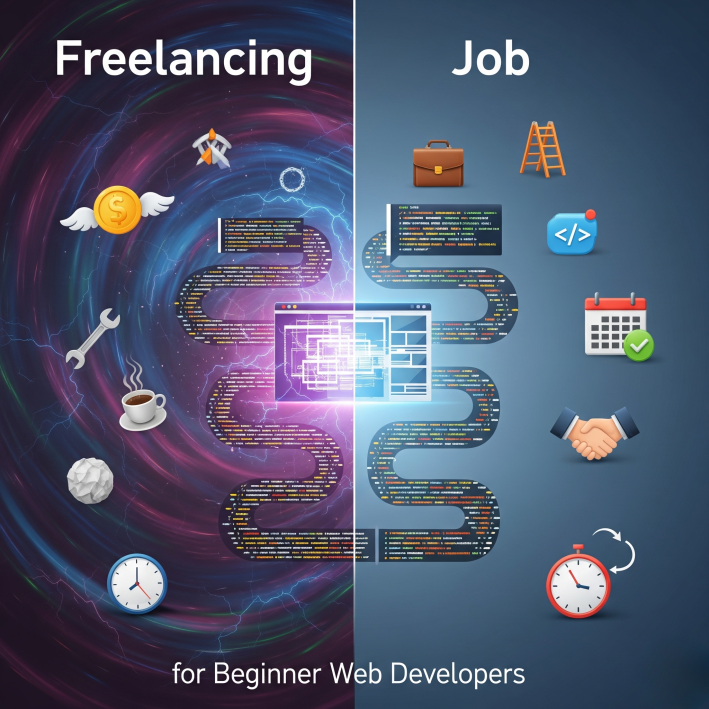
Freelancing vs Job: What Should a Beginner Web Developer Choose?
“Should I Take a Job or Start Freelancing?”
You’ve learned web development.
You built a few projects.
You understand HTML, CSS, JavaScript – maybe even backend basics.
Now comes the big question:
Should I take a job… or start freelancing?
This confusion is common among:
- 11th & 12th students learning coding
- BA, B.Com, BSc students building IT skills
- BCA & B.Tech students planning careers
- Beginners looking for skill-based income
- Freelancing vs Job for Beginner Web Developers
Let’s break this down clearly and practically.
Quick Answer: Which Is Better?
There is no one-size-fits-all answer.
It depends on:
- Your skill level
- Your financial needs
- Your risk tolerance
- Your personality
- Your long-term goals
But for most beginners:
- Starting with a job or internship first is often safer and more structured.
- Freelancing works best after gaining some real-world experience.
Now let’s go deeper.
What Is a Web Developer Job?
A web developer job means:
- Working for a company
- Receiving fixed monthly salary
- Following team processes
- Having structured responsibilities
You might work as:
- Frontend Developer
- Backend Developer
- Full Stack Developer
- Junior Web Developer
Benefits of a Job:
- Fixed monthly income
- Structured learning environment
- Mentorship from senior developers
- Team collaboration experience
- Resume credibility
Challenges:
- Less flexibility
- Fixed working hours
- Salary growth depends on company
What Is Freelancing in Web Development?
Freelancing means:
- Working independently
- Finding your own clients
- Charging per project
- Managing everything yourself
You may build:
- Business websites
- E-commerce stores
- Landing pages
- Portfolio sites
Benefits of Freelancing:
- Flexible schedule
- Unlimited income potential
- Work from anywhere
- Direct client interaction
Challenges:
- No fixed income
- Need to find clients
- Payment delays possible
- High competition initially
Freelancing vs Job: Clear Comparison Table
| Factor | Job | Freelancing |
|---|---|---|
| Income | Fixed Monthly Salary | Project-Based, Variable |
| Stability | High | Medium to Low(initially) |
| Learning Structure | Guided by Seniors | Self Managed |
| Freedom | Limited | High |
| Risk Level | Low | Medium to High |
| Growth | Steady | Fast(if consistent) |
For beginners, stability often matters more than freedom.
Real Student Example
Imagine two students.
Student A – Takes a Job
- Joins as Junior Web Developer
- Earns ₹3–4 LPA
- Learns team workflow
- Gains real project experience
After 1–2 years, can switch jobs or start freelancing confidently.
Student B – Starts Freelancing Immediately
- Creates profile on freelance platforms
- Gets first small project after 1–2 months
- Faces pricing competition
- Learns client handling the hard way
Income may fluctuate in the beginning.
Both paths work — but timing matters.
When Should a Beginner Choose a Job?
Choose a job if:
- You are new to web development
- You lack real project exposure
- You want structured guidance
- You need stable income
- You want to build confidence
A job builds foundation.
When Should a Beginner Choose Freelancing?
Choose freelancing if:
- You already built strong projects
- You understand client communication
- You are self-disciplined
- You can handle income uncertainty
- You want flexibility
Freelancing requires maturity and consistency.
The Smart Strategy: Combine Both
Here’s what many successful developers do:
Step 1:
Start with internship or job.
Step 2:
Build freelance clients part-time.
Step 3:
After stable client flow, decide whether to continue job or go full-time freelance.
This reduces risk.
Web Developer Salary vs Freelance Income in India
Job Salary (Beginner Level)
- ₹2.5–5 LPA (Freshers)
- ₹5–8 LPA (1–3 years experience)
Freelance Income
- ₹8,000–₹25,000 per website (beginner level)
- ₹40,000+ per project (intermediate level)
But remember:
Freelance income is not guaranteed monthly.
Consistency depends on:
- Client acquisition
- Marketing skills
- Networking
Why Skill Level Matters More Than Choice
Freelancing vs job is secondary.
Primary question is:
Are your skills strong enough?
Without strong skills:
- You struggle in job interviews
- You struggle in freelance competition
So first focus on:
- Building solid fundamentals
- Completing real projects
- Creating professional portfolio
Then choose path.
Step-by-Step Career Plan for Students
If you are in 11th, 12th, or graduation:
Step 1: Learn Core Web Development
- HTML
- CSS
- JavaScript
- Backend basics
Step 2: Build 5–6 Real Projects
Show:
- Live project links
- Code repository
- Skills list
Step 3: Create Online Portfolio
Examples:
- Business website
- Portfolio website
- Blog system
- E-commerce demo
Step 4: Apply for Internship or Small Freelance Projects
Gain experience.
After 6–12 months, your confidence grows naturally.
Why This Decision Matters for Your Career
Choosing wisely impacts:
- Income stability
- Learning speed
- Stress level
- Long-term growth
Many students rush into freelancing for “quick money.”
But strong foundation always wins in long-term career growth.
How SiteGenius Helps You Prepare for Both Paths
The SiteGenius Web Development Training Program is designed to prepare students for:
- Industry-level job roles
- Freelancing opportunities
- Real-world projects
- Portfolio building
- Client-ready communication skills
Students learn step-by-step — from basics to advanced.
You can:
- Visit the Curriculum Page to see complete skill roadmap
- Check the Admission Page for upcoming batches
- Attend the Free Awareness session
FAQs- Freelancing vs Job for Beginner Web Developers
1. Should a beginner web developer start with freelancing or job?
Most beginners benefit from starting with a job or internship to gain experience before freelancing.
2. Is freelancing risky for new web developers?
Yes, income can be inconsistent initially. Strong skills and client communication are essential.
3. Can I do freelancing while doing a job?
Yes. Many developers start freelancing part-time while working full-time.
4. Which pays more: job or freelancing?
Freelancing can pay more long-term, but job provides stable monthly income.
5. What is best for students in college?
Start learning early, build projects, take internship first, then gradually explore freelancing.
Final Thoughts: Build Skills First, Decide Later
Freelancing vs job is not a competition.
It is a career stage decision.
As a beginner:
Focus on learning.
Focus on projects.
Focus on confidence.
Once your skills are strong, both paths become powerful opportunities.
If you want structured guidance to become job-ready and freelance-ready, explore the SiteGenius Web Development Training Program and start building your foundation today.
Your career choice becomes easier when your skills are stronger.
Start learning. Build projects. Then choose wisely.