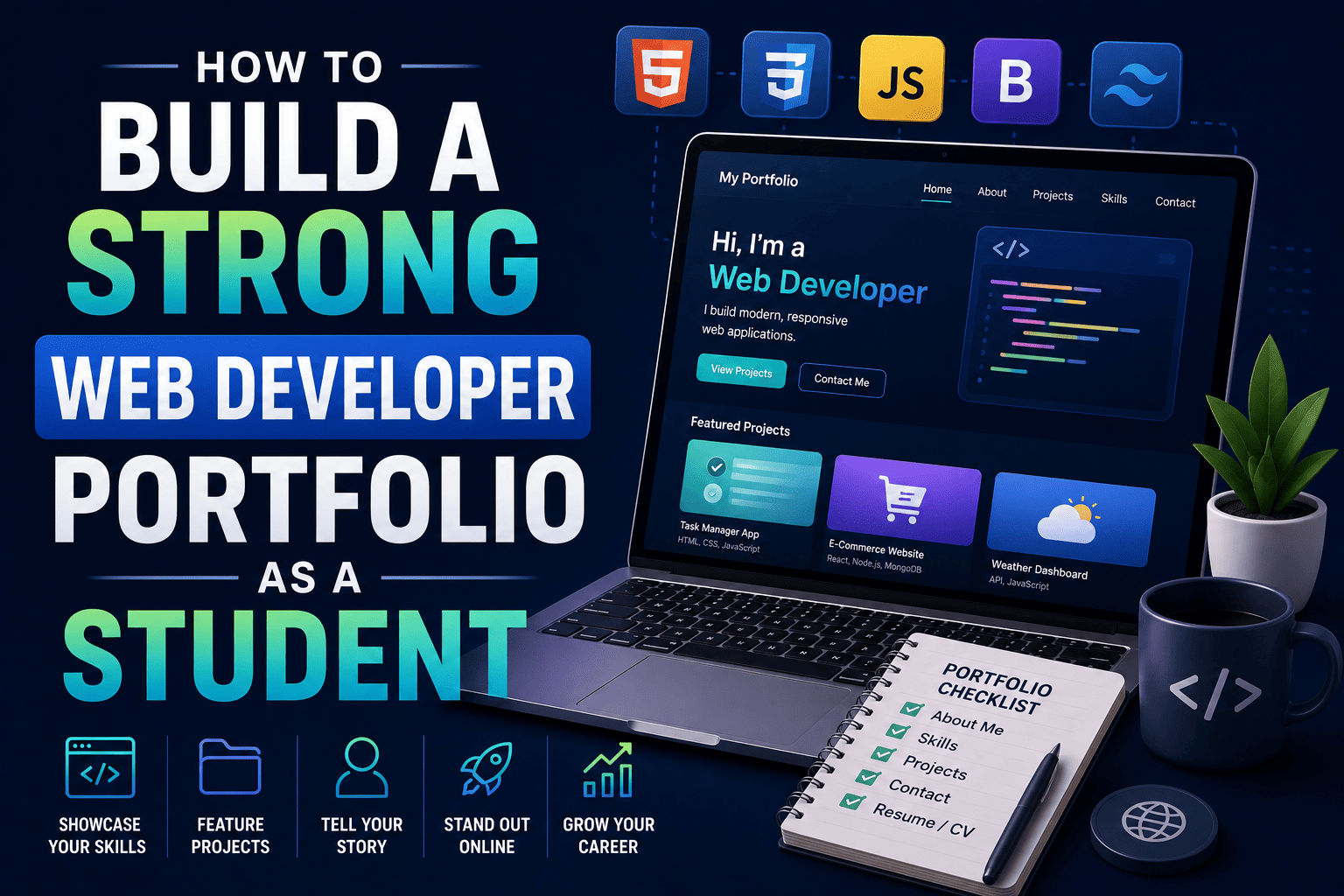
How to Build a Strong Web Developer Portfolio as a Student
Imagine attending a job interview as a student.
The interviewer asks:
“Do you have any projects you’ve worked on?”
You confidently open your laptop and showcase websites you have personally designed and developed.
You show:
- Portfolio websites
- Landing pages
- Business websites
- Interactive web applications
Suddenly, the conversation becomes much more interesting.
This is the power of a strong web developer portfolio.
Today, employers and clients often care less about what you claim to know and more about what you can actually build.
Whether you are a student of 11th & 12th, BA, BCA, BSc, B.Com or B.Tech, having a professional portfolio can dramatically improve your chances of getting internships, freelance projects and job opportunities.
In this guide, you’ll learn how to build a strong web developer portfolio as a student, what projects to include and how to make your portfolio stand out from the crowd.
Why Every Web Development Student Needs a Portfolio
A portfolio is your digital proof of skills.
Instead of simply writing “HTML, CSS and JavaScript” on your resume, you can demonstrate those skills through real projects.
A strong portfolio helps you:
- Showcase practical skills
- Build credibility
- Impress recruiters
- Get internships faster
- Attract freelance clients
- Create a professional online presence
Think of your portfolio as your online showroom.
The better your projects, the stronger your impression.
What Is a Web Developer Portfolio?
A web developer portfolio is a website that showcases your:
- Projects
- Skills
- Experience
- Certifications
- Resume
- Contact information
It acts as a central hub where recruiters, clients and employers can evaluate your abilities.
Unlike a traditional resume, a portfolio provides visual proof of your work.
Why Recruiters Love Strong Portfolios
Many students have similar academic qualifications.
However, not all students have practical projects.
Consider this comparison:
| Student A | Student B |
|---|---|
| Lists skills on resume | Demonstrates skills through projects |
| No portfolio | Professional portfolio website |
| Limited practical evidence | Real-world project examples |
| Harder to evaluate | Easy to assess capabilities |
Recruiters often find Student B more memorable because they can actually see the work.
A portfolio helps transform you from someone who claims to have skills into someone who can prove those skills.
10 Essential Steps to Build a Strong Web Developer Portfolio as a Student
Step 1: Create Your Own Portfolio Website
The first project in your portfolio should be your portfolio itself.
A portfolio website demonstrates:
- Website design skills
- Responsive development
- User experience understanding
- Personal branding
Essential pages to include:
- Home
- About Me
- Projects
- Skills
- Resume
- Contact
A clean, professional website often creates a stronger impression than an overly complicated one.
Step 2: Include Real Projects, Not Just Tutorials
One common mistake students make is adding only tutorial-based projects.
Recruiters can often recognize projects copied directly from YouTube tutorials.
Instead, build projects that solve real problems.
For example:
- Student Attendance System
- College Event Website
- Local Business Website
- Online Quiz Application
- Portfolio Builder
- Job Portal
These projects demonstrate independent thinking, creativity and practical implementation.
Step 3: Showcase Different Types of Projects
Variety makes your portfolio stronger.
Try including projects from different categories:
- Website design projects
- WordPress websites
- JavaScript applications
- Full-stack projects
- UI/UX projects
- Business websites
This demonstrates versatility and adaptability, two qualities employers highly value.
Step 4: Write Strong Project Descriptions
Many students simply upload screenshots and move on.
That is a missed opportunity.
For every project, explain:
- Project objective
- Problem solved
- Technologies used
- Features implemented
- Challenges faced
- Lessons learned
Example:
“This eCommerce website was built using HTML, CSS, JavaScript and PHP. The project allows users to browse products, manage a shopping cart and place orders.”
Clear descriptions help recruiters understand your role, contribution and technical knowledge.
Step 5: Add Live Project Links
Whenever possible, allow visitors to test your projects.
Popular hosting platforms include:
- GitHub Pages
- Netlify
- Vercel
Live projects increase credibility because recruiters can interact with your work directly.
A working project creates a much stronger impression than screenshots alone.
Step 6: Include GitHub Repositories
GitHub acts as a portfolio for your code.
Employers often review code quality in addition to website design.
Benefits of GitHub:
- Demonstrates coding ability
- Shows project history
- Displays consistency
- Highlights technical skills
Even beginner projects can make a positive impression when organized properly.
Step 7: Highlight Your Technical Skills
Create a dedicated skills section.
Common web development skills include:
- HTML
- CSS
- JavaScript
- Bootstrap
- WordPress
- PHP
- MySQL
- React
- Git & GitHub
Only include skills you have actually practiced.
Authenticity is more important than a long list of technologies.
Step 8: Add Certifications and Achievements
Certifications can strengthen your portfolio when combined with practical work.
You can include:
- Web development certificates
- Internship certificates
- Competition achievements
- Workshop participation
- Online course completion
However, remember that projects usually carry more weight than certificates alone.
Step 9: Make Your Portfolio Mobile-Friendly
Most recruiters browse websites on mobile devices.
A portfolio that looks broken on smartphones creates a poor impression.
Test your portfolio on:
- Smartphones
- Tablets
- Laptops
- Desktop computers
Responsive design is a fundamental skill every web developer should demonstrate.
Step 10: Keep Updating Your Portfolio
Your portfolio should evolve as your skills grow.
Regularly update:
- New projects
- New certifications
- Internship experience
- Technical skills
- Achievements
An updated portfolio shows continuous learning, consistency and dedication.
Powerful Portfolio Projects Students Can Include
If you’re unsure what to build, consider these project ideas:
Beginner-Level Projects:
- Personal portfolio website
- Restaurant website
- Travel website
- Landing page
- Blog website
Intermediate-Level Projects:
- Student management system
- Weather application
- Online quiz system
- Task management application
- Event management portal
Advanced-Level Projects:
- E-commerce platform
- Job portal
- Learning management system
- Freelance marketplace
- Social networking platform
The goal is not to build hundreds of projects.
The goal is to build a few high-quality projects that demonstrate real skills.
Common Portfolio Mistakes Students Should Avoid
Even talented students make mistakes when building portfolios.
Avoid these common errors:
- Using outdated designs
- Adding unfinished projects
- Including copied projects
- Ignoring mobile responsiveness
- Providing no project descriptions
- Using poor-quality screenshots
- Forgetting contact information
A simple, polished portfolio usually performs better than a cluttered one.
Why Building a Portfolio Matters for Your Career
A strong portfolio can open doors long before graduation.
It can help students:
- Secure internships
- Win freelance projects
- Impress placement recruiters
- Build personal branding
- Gain confidence during interviews
In today’s competitive market, practical proof of skills often matters more than theoretical knowledge alone.
Why Portfolio Development Is One of the Most Valuable Skills
When students build portfolios, they naturally learn:
- Website design
- Frontend development
- Problem-solving
- Project planning
- SEO basics
- User experience principles
These skills remain valuable across multiple career paths.
Whether you become:
- A web developer
- Freelancer
- Digital marketer
- Entrepreneur
A strong portfolio can continue creating opportunities throughout your career.
How SiteGenius Helps Students Build Industry-Ready Portfolios
Many students struggle because they learn concepts without applying them.
The SiteGenius Web Development Training Program focuses on practical learning and portfolio creation.
Students learn:
- WordPress website development
- Responsive website design
- HTML, CSS and JavaScript fundamentals
- Website optimization
- SEO basics
- Real-world project implementation
Instead of simply learning theory, students work on practical projects that can become part of their portfolios.
The program is suitable for:
- 11th & 12th students
- BA, BCA, BSc, B.Com students
- B.Tech students
- Beginners interested in web development
You can:
- Explore the curriculum page to see skill modules
- Visit the admission page for batch details
- Attend the free Awareness session
FAQs- How to Build a Strong Web Developer Portfolio as a Student
Do students need a portfolio to get web development internships?
While not mandatory, a portfolio significantly improves your chances because it provides proof of practical skills.
How many projects should a beginner portfolio include?
A portfolio with 5-10 high-quality projects is usually more effective than one with many unfinished projects.
Can I build a portfolio without professional experience?
Yes. Student projects, personal projects and academic projects are all valuable additions to a portfolio.
Should I use WordPress or coding to build my portfolio website?
Both are good options. Beginners may start with WordPress, while students interested in coding can build custom portfolios using HTML, CSS and JavaScript.
How often should I update my portfolio?
Update your portfolio whenever you complete a new project, certification or internship.
Conclusion
A strong web developer portfolio is one of the most powerful career assets a student can build.
It demonstrates practical skills, showcases creativity and helps recruiters understand your capabilities beyond academic marks.
Start small.
Build meaningful projects.
Keep improving consistently.
Most importantly, do not wait until graduation to begin.
Remember:
Your portfolio is not just a collection of projects.
It is a reflection of your growth, dedication and potential as a future web developer.