
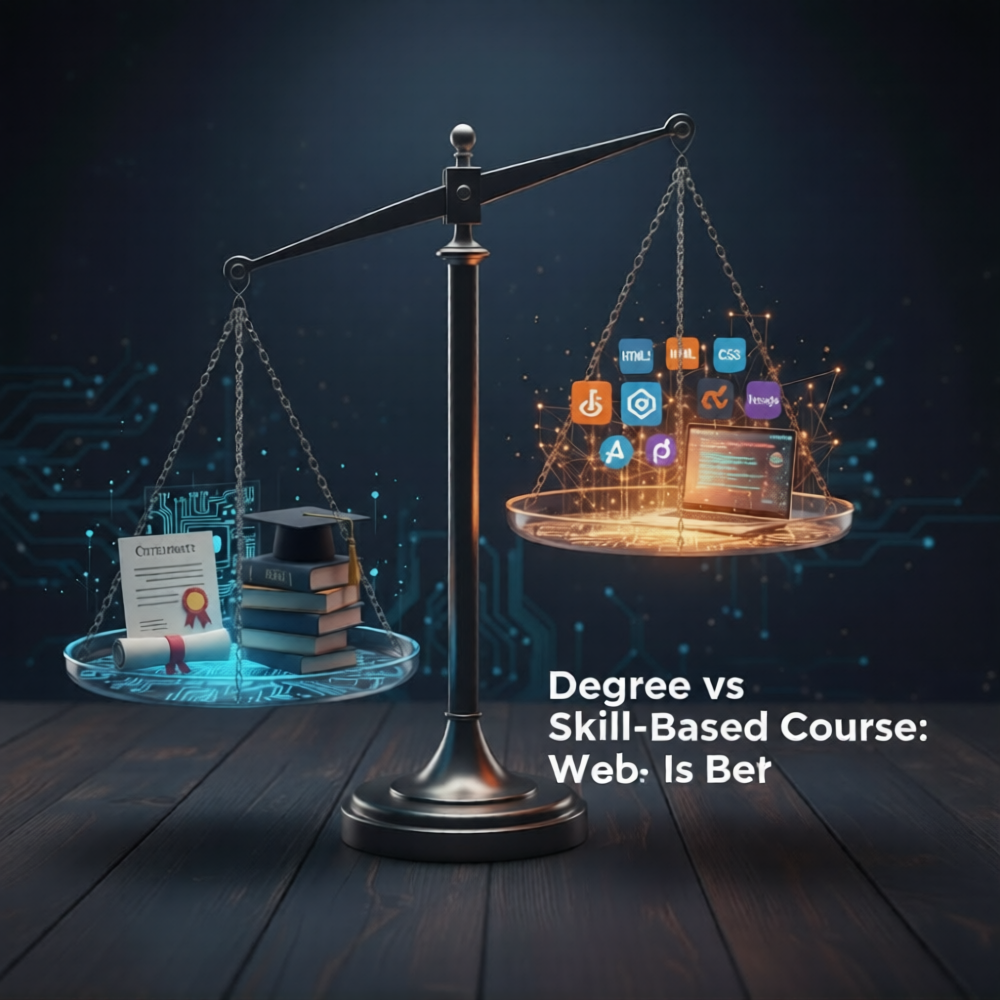
Degree vs Skill-Based Course: What Is Better for Web Development?
The Big Career Dilemma
If you are in 11th, 12th, or college, you have probably heard this advice:
“First complete your degree. Skills can come later.”
But at the same time, you also see students earning from freelancing, internships, and coding – even before graduation.
So now you are confused:
Should I choose a traditional degree or a skill-based course for web development?
This is one of the most important career decisions in 2026.
Let’s break it down clearly and honestly.
Understanding the Two Paths
Before choosing, you must understand what each option actually offers.
What Is a Degree in Web Development?
Examples include:
- BCA
- BSc IT
- B.Tech
- Computer Science degree
A degree usually focuses on:
- Theory
- Programming concepts
- Academic exams
- Broader computer science subjects
Duration: 3-4 years.
What Is a Skill-Based Course?
A skill-based web development course focuses on:
- Practical coding
- Real-world projects
- Industry tools
- Portfolio building
- Job-ready training
Duration: 6-12 months (depending on intensity).
The focus is on doing, not just studying.
Degree vs Skill-Based Course - Detailed Comparison
Degree vs Skill-Based Course- Let’s compare both paths
| Factor | Traditional Degree | Skill Based Course |
|---|---|---|
| Duration | 3-4 Years | 6-12 Months |
| Focus | Theory + Exams | Practical Skills |
| Projects | Limited | Real - World Projects |
| Portfolio | Rarely Strong | Strong Portfolio |
| Industry Readiness | Moderate | High |
| Cost | High | Usually Lower |
| Earning Potential | Delayed | Faster Start |
Both have value. But they serve different purposes.
Is a Degree Necessary for Web Development?
Short answer: No.
Many successful web developers:
- Are self-taught
- Come from non-IT backgrounds
- Have degrees unrelated to computer science
Companies primarily check:
- Your skills
- Your portfolio
- Your problem-solving ability
However, a degree can help if you:
- Want government jobs
- Plan higher studies
- Prefer structured academic learning
But for pure web development roles, skills matter more than certificates.
What Employers Really Look For in 2026
When companies hire web developers, they check:
- Can you build a complete website?
- Do you understand frontend and backend?
- Can you debug errors?
- Have you worked on live projects?
- Do you understand Git and deployment?
Notice something?
They test skills – not marks.
This is why many graduates struggle in interviews. They have degrees but lack hands-on experience.
Career Growth: Which Path Helps Faster?
Let’s examine from a practical perspective.
Scenario 1: Only Degree
- 3 years of theory
- Limited projects
- Job search after graduation
- Initial struggle due to lack of practical exposure
Scenario 2: Degree + Skill-Based Training
- Academic knowledge
- Real-world project experience
- Strong portfolio
- Internship opportunities during college
Which one sounds more powerful?
In 2026, the smartest approach is combining both – if possible.
After 12th: What Should You Choose?
If you just completed 12th, you have three options:
Option 1: Only Degree
Safe but slow practical exposure.
Option 2: Only Skill-Based Course
Fast entry into industry, but no formal degree.
Option 3: Degree + Structured Skill Training (Recommended)
Best of both worlds.
Many successful students pursue:
- BA/BCom/BSc
- Alongside web development training
This gives them flexibility and career strength.
Why Skill-Based Learning Is Powerful in 2026
The digital world moves fast.
New technologies appear every year.
Traditional degrees sometimes update slowly.
Skill-based programs focus on:
- Current industry tools
- Real project building
- Practical exposure
- Job-ready preparation
This reduces the gap between learning and earning.
Who Should Choose a Skill-Based Web Development Course?
It is ideal for:
- Students who want early earning
- Beginners who prefer practical learning
- College students who want internships
- Students from non-technical streams
- Anyone looking for skill-based IT career options
You do not need advanced mathematics.
You need:
- Consistency
- Curiosity
- Practice
Common Mistakes Students Make
Many students:
- Depend only on their degree
- Do not build projects
- Avoid internships
- Start skill training too late
This delays career growth.
Starting skill-building early creates a competitive advantage.
How SiteGenius Helps You Make the Right Choice
The SiteGenius Web Development Training Program is designed to bridge the gap between academic learning and industry expectations.
It focuses on:
- Step-by-step structured curriculum
- Real-world project development
- Portfolio building
- Practical implementation
- Career-focused training
Whether you are:
- In 12th
- Pursuing BA, BCom, BSc
- Studying BCA or B.Tech
- A complete beginner
The program helps you become industry-ready.
You can:
- Explore the curriculum page to understand the complete roadmap
- Visit the admission page for batch details
- Attend a free Awareness session
What Is the Best Strategy in 2026?
Here is a powerful strategy:
- Pursue a degree for long-term flexibility.
- Simultaneously build practical skills through structured training.
- Build a strong portfolio.
- Do internships before graduation.
By the time others start job hunting, you are already experienced.
FAQs - Degree vs Skill-Based Course for Web Development
1. Is a degree required to become a web developer?
No. Skills and project experience matter more than formal degrees in most web development jobs.
2. Can I become a web developer after 12th without a degree?
Yes. You can start learning web development immediately after 12th through structured skill-based courses.
3. Which is better for salary growth?
Skill-based training combined with real project experience typically leads to faster salary growth.
4. Should I skip degree and only do a course?
It depends on your goals. If you want flexibility for higher studies or government jobs, a degree helps. For pure web development careers, strong skills are essential.
5. How long does it take to become job-ready?
With consistent learning and practical training, students can become internship-ready within 6-12 months.
Final Thoughts: Choose Smart, Not Traditional
The question is not “Degree or Skill?”
The real question is:
“How fast do you want to become industry-ready?”
In 2026, companies reward capability.
If you build strong web development skills early, you create:
- Faster earning opportunities
- Stronger job confidence
- Better salary growth
- Career flexibility
If you want structured guidance, explore the SiteGenius Web Development Training Program and start building real skills alongside your academic journey.
Your future will not depend only on a certificate.
It will depend on what you can actually build.