
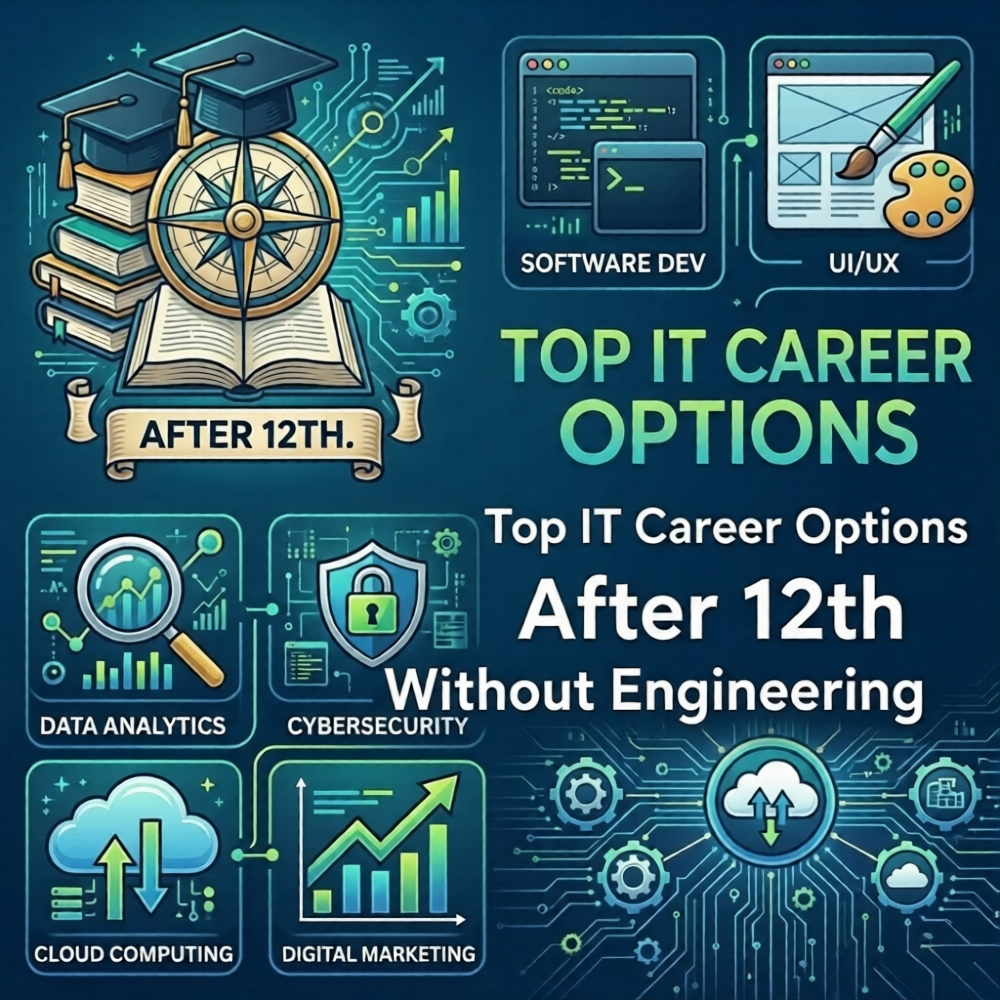
Top IT Career Options After 12th Without Engineering
“Do I Need Engineering to Enter IT?”
Many students believe:
“If I don’t do B.Tech, I can’t enter IT.”
This is one of the biggest myths in India.
The truth is:
You do not need engineering to build a successful IT career.
In 2026, companies hire based on:
- Skills
- Projects
- Practical knowledge
- Problem-solving ability
Not just degrees.
If you are in 11th or 12th (Commerce, Arts, or Science) — this guide will show you Top IT Career Options After 12th Without Engineering
Why IT Careers Are No Longer Limited to Engineers
The IT industry has changed.
Earlier:
Only engineering graduates dominated IT jobs.
Now:
Skill-based hiring is increasing.
Startups, digital agencies, and tech companies care more about:
- What you can build
- Your portfolio
- Real-world projects
- Hands-on experience
This opens doors for non-engineering students.
Top IT Career Options After 12th Without Engineering
Let’s explore the best options.
1. Web Development (Highly Recommended)
Web development is one of the best IT career options after 12th.
You build:
- Websites
- E-commerce stores
- Web applications
- Online platforms
Why It’s Great for Non-Engineers
- Beginner-friendly
- Fast learning curve
- High demand
- Freelancing options
- Remote job opportunities
Salary Range (India)
- Fresher: ₹2.5–5 LPA
- Experienced: ₹8–15 LPA
Web development is skill-based, not degree-based.
2. Digital Marketing
Digital marketers handle:
- SEO
- Social media
- Online ads
- Content marketing
Why It’s Popular
- Creative + analytical
- Good for commerce & arts students
- Freelance-friendly
Salary Range:
₹2-6 LPA (entry level)
3. UI/UX Design
UI/UX designers improve:
- Website design
- App experience
- User interaction
Great for students who enjoy creativity.
Salary Range:
₹3-8 LPA
4. Graphic Design
Graphic designers create:
- Social media creatives
- Brand designs
- Website visuals
Creative career option without engineering.
5. Data Entry & IT Support Roles
These are basic IT roles:
- Entry-level
- Limited growth
- Lower salary compared to development roles
Good starting point, but not high-growth long-term.
Comparison Table: Best IT Careers Without Engineering
| Career Option | Growth | Salary Potential | Technical Level | Freelance Scope |
|---|---|---|---|---|
| Web Development | High | High | Moderate | Very High |
| Digital Marketing | High | Moderate | Low-Moderate | High |
| UI/UX Design | High | Moderate-High | Moderate | High |
| Graphic Design | Moderate | Moderate | Low | High |
| IT Support | Low | Low | Low | Low |
👉 Web development stands out for long-term growth.
Why Web Development Is the Smartest Choice
Let’s be practical.
Web development offers:
- High demand
- Strong salary growth
- Global opportunities
- Remote work
- Freelancing potential
- Startup flexibility
And most importantly –
You can start from zero.
Step-by-Step Roadmap to Start IT Career After 12th
If you want to choose web development, follow this roadmap.
Step 1: Learn Basics (2–3 Months)
Start with:
- HTML
- CSS
- JavaScript
Build small websites.
Step 2: Build Projects (3–6 Months)
Create:
- Portfolio website
- Business website
- Blog system
- E-commerce demo
Projects build confidence.
Step 3: Learn Backend & Full Stack (6–9 Months)
Understand:
- Databases
- Server logic
- API integration
Now you become job-ready.
Step 4: Internship or Freelancing
Gain real experience.
Even small freelance projects help build credibility.
Real Student Example
Imagine two students after 12th.
Student A:
Joins random graduation without skill focus.
Student B:
Learns web development alongside graduation.
After 3 years:
Student B already has:
- Internship experience
- Portfolio
- Technical skills
Who will have stronger career opportunities?
Skill-building early changes your career path.a
Can Commerce & Arts Students Enter IT?
Yes.
Web development does not require:
- Advanced mathematics
- Physics background
- Engineering degree
It requires:
- Logical thinking
- Practice
- Consistency
Many successful developers come from:
- B.Com
- BA
- BSc
- BCA
Background does not limit you.
Why Skill-Based Careers Are the Future
Degrees give knowledge.
Skills give income.
In today’s digital economy:
- Businesses need developers
- Startups need websites
- E-commerce is expanding
- Online services are growing
Skill-based careers grow faster than traditional paths.
How SiteGenius Helps You Build a Strong IT Career
The SiteGenius Web Development Training Program is designed especially for beginners and non-engineering students.
It focuses on:
- Step-by-step structured curriculum
- Full stack development
- Real-world project building
- Portfolio creation
- Career guidance
Students don’t just learn theory – they build actual websites.
If you want to explore further:
- Visit the Curriculum Page to see complete roadmap
- Check the Admission Page for upcoming batches
- Attend the Free Awareness Session
FAQs- IT Career After 12th Without Engineering
1. Can I get an IT job without engineering degree?
Yes. Many IT roles, especially web development and digital marketing, are skill-based.
2. Which IT field is best after 12th without engineering?
Web development is one of the best options due to high demand and salary growth.
3. Is web development hard for beginners?
It may feel new initially, but with structured guidance, beginners can learn it step by step.
4. Can commerce students enter IT field?
Yes. IT careers today are open to commerce and arts students as well.
5. How long does it take to become job-ready?
With consistent learning, students can become internship-ready within 6–12 months.
Final Thoughts: Engineering Is Not the Only Path
Your career is not limited by your stream.
It is shaped by your skills.
If you want:
- A high-growth industry
- Strong earning potential
- Flexible career options
- Future-ready skills
Web development is one of the smartest IT career options after 12th without engineering.
If you’re serious about building a strong foundation, explore the SiteGenius Web Development Training Program and start learning the skills that companies actually hire for.
Your IT career doesn’t begin with engineering.
It begins with a decision.