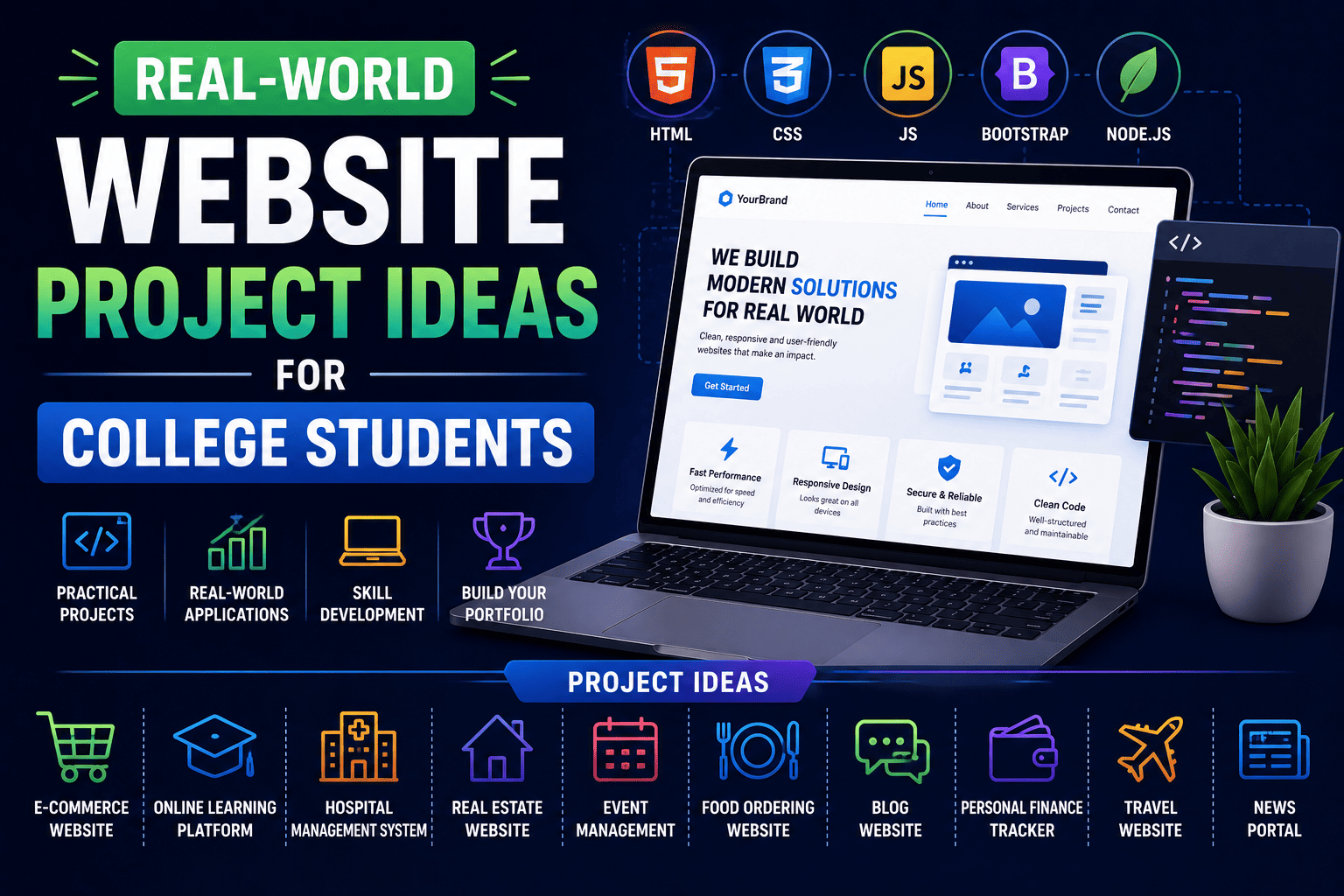
Real-World Website Project Ideas for College Students
Imagine sitting in a campus placement interview.
The recruiter asks:
“What projects have you built?”
You mention a few tutorial projects you followed online.
Then another student walks in and shows a fully functional college event website, a restaurant booking platform, and a student portfolio website.
Who do you think leaves a stronger impression?
In today’s competitive job market, employers want more than theoretical knowledge. They want proof that you can solve real problems using technology.
That is where real-world website projects become valuable.
Whether you are studying in BCA, BSc, B.Com, BA, B.Tech, or even in 11th and 12th, building practical projects can significantly improve your skills, portfolio, and career opportunities.
In this guide, you’ll discover some of the best real-world website project ideas for college students and learn how these projects can help you become a stronger web developer.
Why Real-World Projects Matter More Than Tutorial Projects
Tutorials are useful for learning concepts.
However, real growth happens when you build something on your own.
Real-world projects help students:
- Apply technical knowledge
- Improve problem-solving skills
- Build confidence
- Create portfolio-worthy work
- Gain practical experience
- Prepare for internships and jobs
When you solve an actual problem through a website, you learn much more than simply following instructions.
What Makes a Website Project "Real-World"?
A real-world project is designed to solve a practical problem.
Instead of creating random pages, you build something that users can actually benefit from.
A strong real-world project usually has:
- A clear purpose
- Target users
- Useful features
- Responsive design
- Professional appearance
- Practical functionality
These are the types of projects recruiters and clients appreciate.
15 Real-World Website Project Ideas for College Students
1. College Event Management Website
Many colleges organize seminars, workshops, and cultural events.
Build a website where students can:
- View upcoming events
- Register online
- Download schedules
- Receive updates
This project demonstrates practical problem-solving abilities.
2. Student Portfolio Website
Every web development student should have a portfolio website.
Include:
- About section
- Skills
- Projects
- Resume
- Contact form
A portfolio website is both a project and a career tool.
3. Local Business Website
Many small businesses still lack professional websites.
Create a website for:
- Restaurants
- Salons
- Coaching centers
- Local stores
This project closely resembles real client work.
4. Online Quiz Platform
Students frequently use quiz platforms for learning and assessment.
Features can include:
- Multiple-choice questions
- Score calculation
- Results page
- User tracking
This project strengthens JavaScript and database skills.
5. Restaurant Reservation Website
Allow users to:
- View menus
- Reserve tables
- Check timings
- Contact the restaurant
This project demonstrates practical business website development.
6. Job Portal for Students
Many students search for internships and part-time opportunities.
A student-focused job portal can include:
- Job listings
- Internship opportunities
- Application forms
- Employer profiles
This is an excellent portfolio project.
7. Online Learning Platform
Build a website where students can:
- Browse courses
- Watch lessons
- Track progress
- Download resources
This project introduces concepts used in modern educational websites.
8. Freelance Service Website
Create a platform where freelancers can showcase services.
Possible categories:
- Graphic design
- Content writing
- Web development
- Digital marketing
This project teaches business-oriented web development.
9. Fitness Tracking Website
Health and fitness applications are increasingly popular.
Users can:
- Track workouts
- Monitor goals
- Record progress
- View statistics
This project combines design and functionality.
10. Expense Management System
College students often struggle with budgeting.
Build a website that helps users:
- Track expenses
- Manage budgets
- Analyze spending habits
This project provides practical value and strengthens development skills.
11. Online Book Exchange Platform
Students frequently buy and sell academic books.
A book exchange website can include:
- Book listings
- Search functionality
- User profiles
- Contact options
This project solves a common student problem.
12. Travel Planning Website
Allow users to explore destinations and create travel plans.
Features may include:
- Destination information
- Trip planning tools
- Budget estimators
- Image galleries
This project improves frontend and UI design skills.
13. Hospital Appointment Booking Website
Healthcare websites are widely used.
Users should be able to:
- Search doctors
- Book appointments
- View schedules
- Contact clinics
This project demonstrates real-world business requirements.
14. Real Estate Listing Website
Property websites remain highly relevant.
Include features such as:
- Property listings
- Search filters
- Contact forms
- Location information
This project closely resembles commercial web development.
15. Community Forum Website
Create a platform where users can:
- Ask questions
- Share information
- Participate in discussions
This project introduces user-generated content management.
How to Choose the Right Project
Not every project is suitable for every student.
Choose a project based on:
- Current skill level
- Interests
- Career goals
- Available time
For beginners
- Portfolio website
- Business website
- Blog website
For intermediate learners
- Quiz application
- Expense tracker
- Event management system
As your skills improve, move toward more advanced projects.
Project Ideas Based on Skill Level
| Skill Level | Recommended Projects |
|---|---|
| Beginner | Portfolio Website, Blog Website, Business Website |
| Intermediate | Quiz Platform, Expense Tracker, Restaurant Website |
| Advanced | Job Portal, Learning Platform, Community Forum |
Choosing projects according to your skill level increases the chances of successful completion.
Why Real-World Projects Help Your Career
Recruiters often receive hundreds of resumes.
Projects help you stand out.
Real-world projects demonstrate:
- Practical experience
- Technical knowledge
- Problem-solving ability
- Creativity
- Initiative
A student with strong projects often has a significant advantage during internships and placement drives.
Common Mistakes Students Should Avoid
Many students unknowingly weaken their portfolios.
Avoid these mistakes:
- Copying tutorial projects exactly
- Building projects without a clear purpose
- Ignoring responsive design
- Leaving projects unfinished
- Not documenting project details
- Choosing projects beyond current skill levels
A completed, polished project is far more valuable than an unfinished complex application.
Why Project-Based Learning Is Essential
Reading about web development is useful.
Building websites is transformational.
When students create projects, they naturally learn:
- Website planning
- Frontend development
- User experience design
- Problem-solving
- Testing and debugging
- Project management
These skills are highly valued across the technology industry.
How SiteGenius Helps Students Build Industry-Ready Projects
Many students struggle because they learn concepts but never apply them to real situations.
The SiteGenius Web Development Training Program focuses on practical learning through project development.
Students learn:
- HTML, CSS and JavaScript fundamentals
- WordPress website development
- Responsive web design
- Website deployment
- SEO basics
- Real-world project implementation
Instead of only learning theory, students build projects that can be added directly to their portfolios.
This practical approach helps students become more confident, skilled, and career-ready.
You can:
- Explore the curriculum page to see skill modules
- Visit the admission page for batch details
- Attend the free Awareness session
FAQs- Real-World Website Project Ideas for College Students
What are real-world website projects?
Real-world website projects are websites designed to solve actual problems or serve real users, such as business websites, booking systems, or educational platforms.
Which website project is best for college students?
A portfolio website, event management system, or business website are excellent choices because they are practical and portfolio-friendly.
How many projects should students include in a portfolio?
Most students should aim for 5-10 high-quality projects that demonstrate different skills and technologies.
Can website projects help me get internships?
Yes. Projects provide practical proof of your skills and help recruiters evaluate your capabilities more effectively.
Should beginners start with advanced projects?
No. Beginners should start with smaller projects and gradually move toward more complex applications as their skills improve.
Conclusion
Real-world website projects are one of the fastest ways to develop practical web development skills.
They help transform knowledge into experience, strengthen your portfolio, and prepare you for real career opportunities.
Start with a project that solves a real problem.
Focus on learning through building.
Keep improving with every project you complete.
Remember, every professional web developer started by building small projects that gradually led to bigger opportunities.
Your next project could be the one that opens the door to your first internship, freelance client, or dream career.