
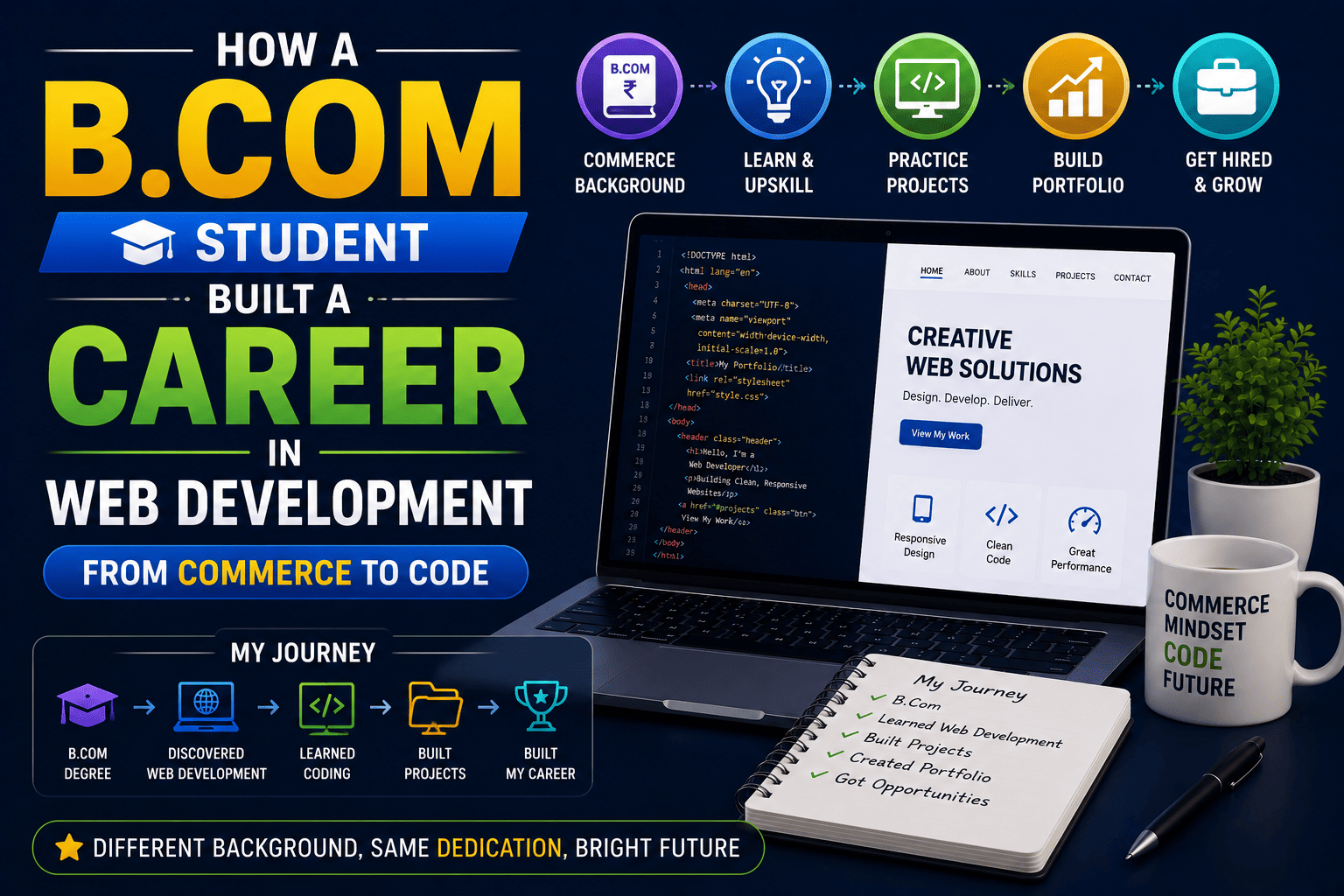
How a B.Com Student Built a Career in Web Development
A Different Career Choice That Changed Everything
For many BCom students, graduation brings excitement as well as uncertainty. Questions about higher education, job opportunities, and long-term career growth often create confusion.
Some students pursue traditional career paths such as MCom, MBA, banking, or government exams. Others explore professional certifications in accounting and finance. However, a growing number of students are discovering skill-based careers that offer flexibility, creativity, and strong earning potential.
This is the story of a commerce student who chose an unconventional path. Instead of limiting himself to traditional career options, he decided to learn web development. What started as curiosity eventually became a rewarding profession.
If you are searching for the best career after BCom, this success story may inspire you to explore opportunities beyond conventional choices.
Can a BCom Student Build a Career in Web Development?
The Simple Answer: Absolutely
Many students assume that web development is only for engineering or computer science graduates. This misconception prevents countless talented students from entering one of the fastest-growing industries in the world.
The truth is that web development is a skill-based profession. Employers and clients often focus more on:
- Practical skills
- Project experience
- Problem-solving ability
- Portfolio quality
- Continuous learning mindset
This means students from commerce, arts, and science backgrounds can succeed if they are willing to learn and practice consistently.
Why He Started Looking Beyond Traditional Career Options After BCom
After completing his BCom degree, the student explored several common career paths.
Popular Career Choices He Considered
| Career Path | Challenge |
|---|---|
| MBA | High cost and significant time commitment |
| MCom | Limited practical skill development |
| Banking Exams | Highly competitive |
| Government Jobs | Uncertain timelines and intense competition |
| Entry-Level office jobs | Limited growth opportunities initially |
While researching career options, he noticed something interesting.
Almost every business was investing in digital transformation. Companies needed websites, online stores, digital marketing platforms, and web applications.
This growing demand pointed toward a promising opportunity: web development.
The Turning Point: Discovering a Skill-Based Career
One day, he came across several success stories of students who had built careers through web development.
What caught his attention was that many of them were not engineering graduates.
They had learned practical skills, built projects, created portfolios, and secured opportunities based on their abilities rather than their degrees.
This realization changed his perspective.
A Powerful Lesson
Degrees can open doors, but skills help you grow inside the room.
Instead of spending months worrying about the perfect career choice, he decided to start learning a practical skill that businesses actively needed.
How He Started His Journey into Web Development
Step 1: Understanding the Basics
The first few weeks were spent understanding fundamental concepts.
He learned:
- What web development is
- How websites function
- What frontend and backend development mean
- How domains and hosting work
- The role of web developers in businesses
These concepts created a strong foundation for further learning.
Step 2: Learning Core Web Development Skills
Every web developer starts with essential technologies.
- HTML: HTML helps create the structure of a webpage.
- CSS: CSS controls the appearance and design of websites.
- JavaScript: JavaScript makes websites interactive and dynamic.
Initially, these technologies seemed difficult. However, consistent practice and project-based learning helped him understand them gradually.
Step 3: Building Small Projects
Learning theory alone was not enough.
He started creating small projects such as:
- Personal profile websites
- Portfolio pages
- Business landing pages
- Blog layouts
- Responsive website designs
Every project improved his confidence and strengthened his practical knowledge.
How Practical Projects Accelerated Learning
One of the biggest breakthroughs came when he stopped focusing only on tutorials and started building real projects.
Examples of Beginner-Friendly Projects
- Personal portfolio website
- Restaurant website
- Coaching institute website
- Event registration page
- Small e-commerce homepage
Each project taught him something new about design, coding, and user experience.
Most importantly, these projects later became part of his portfolio.
Why Building a Portfolio Matters More Than You Think
Many beginners underestimate the importance of a portfolio.
A portfolio allows students to showcase:
- Skills
- Projects
- Creativity
- Problem-solving ability
- Professional growth
When applying for internships, freelance opportunities, or jobs, a strong portfolio often creates a better impression than a resume alone.
What His Portfolio Included
- Personal introduction
- Skills section
- Project gallery
- Contact information
- Live project links
This portfolio became one of the most valuable assets in his career journey.
Career After BCom: Why Web Development Makes Sense
Web development offers several advantages for commerce students.
High Demand Across Industries
Every industry needs websites.
Examples include:
- Education
- Healthcare
- Retail
- Real estate
- Finance
- Hospitality
This demand creates long-term career opportunities.
Multiple Income Opportunities
Web development skills can be used for:
- Full-time jobs
- Freelancing
- Remote work
- Agency work
- Entrepreneurship
This flexibility makes it an attractive option for students seeking financial independence.
Growth Based on Skills
Unlike some careers where advancement depends heavily on qualifications, web development rewards practical expertise and continuous improvement.
Traditional Career Path vs Skill-Based Career Path
| Traditional Route | Skill-Based Route |
|---|---|
| Qualification-focused | Skill-focused |
| Longer timeline | Faster practical exposure |
| Limited portfolio | Strong project portfolio |
| Theory-heavy | Hands-on learning |
| Fixed career options | Multiple career paths |
This comparison helped the student realize that skill development could complement his commerce education rather than replace it.
How SiteGenius Helps Students Build Industry-Ready Skills
One challenge faced by many beginners is knowing what to learn and in what order.
Without a roadmap, students often jump between tutorials and become overwhelmed.
The SiteGenius Web Development Training Program helps solve this problem through a structured learning approach.
Students learn:
- Web development fundamentals
- HTML, CSS, and JavaScript basics
- WordPress website creation
- Elementor website design
- Website optimization
- SEO fundamentals
- Portfolio development
- Real-world project building
The focus is on practical implementation rather than theoretical learning alone.
You can:
- Explore the curriculum page to see skill modules
- Visit the admission page for batch details
- Attend the free Awareness session
Lessons Students Can Learn from This Success Story
1. Do Not Let Your Degree Define Your Limits: A commerce background does not prevent you from entering the technology industry.
2. Start Before You Feel Ready: Most successful professionals started as complete beginners.
3. Focus on Building Skills: Skills create opportunities in today’s digital economy.
4. Build Projects Consistently: Projects transform theoretical knowledge into practical expertise.
5. Follow a Structured Learning Path: A clear roadmap reduces confusion and accelerates progress.
What Can You Do Today?
Whether you are:
- A BCom student
- A BA student
- A BSc student
- A BCA student
- A Class 11 or 12 student
You can begin building valuable digital skills immediately.
Start by:
- Learning web development fundamentals.
- Building simple projects.
- Creating a portfolio website.
- Practicing consistently.
- Following a structured training roadmap.
Small actions today can create significant opportunities tomorrow.
FAQs- How a B.Com Student Built a Career in Web Development
What is the best career after BCom for students interested in technology?
Web development is one of the most promising skill-based career options because it offers strong demand, practical learning opportunities, and multiple income streams.
Can a BCom student become a web developer?
Yes. Web development is a skill-based field where practical knowledge, projects, and portfolios often matter more than academic background.
How long does it take to learn web development?
Most students can build foundational skills and complete beginner-level projects within a few months of consistent learning and practice.
Do I need coding experience to start web development?
No. Many successful developers begin with no prior technical knowledge and learn step by step.
Is web development a good career in India?
Yes. The demand for websites, digital platforms, and online business solutions continues to grow, creating opportunities for skilled web developers.
Conclusion: Your Career Story Can Begin Today
This student’s journey demonstrates that success does not always follow a traditional path.
By choosing to learn web development, building projects, and developing practical skills, he created opportunities that extended far beyond his academic background.
If you are searching for the best career after BCom, consider exploring skill-based fields that align with modern industry demands.
Web development is not just about coding. It is about creating solutions, building digital experiences, and developing skills that remain valuable in a rapidly evolving world.
Start learning, build your first project, explore structured training, and take the first step toward creating your own success story.