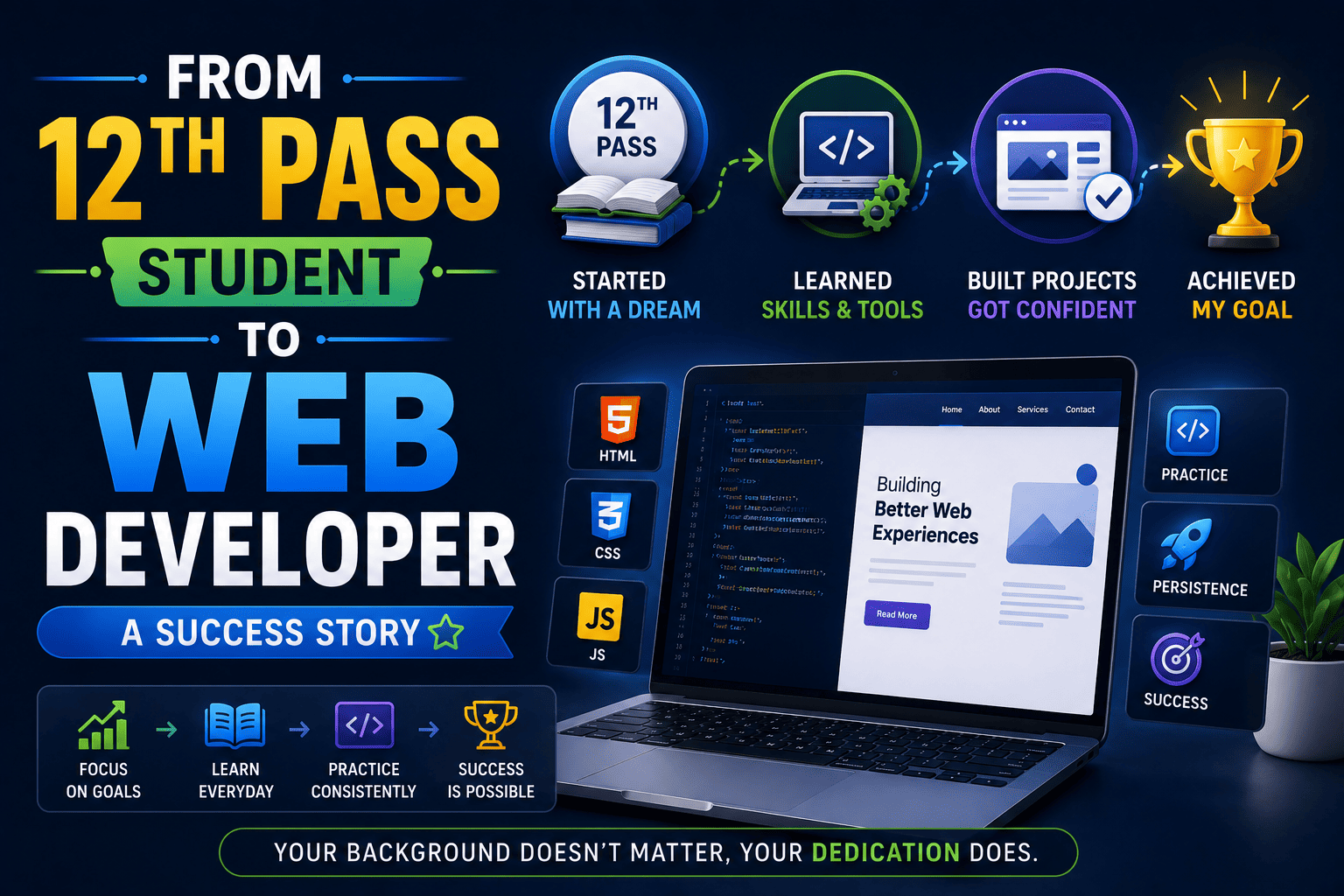
From 12th Pass Student to Web Developer: A Success Story
One Decision That Changed Everything
After completing Class 12, many students find themselves standing at a crossroads. Some choose traditional degree programs without a clear career goal. Others spend months trying to decide which path offers real opportunities in today’s digital world.
This is the story of a student who started with no programming knowledge, no professional experience, and no clear roadmap. Like thousands of students across India, he had only one thing – the willingness to learn.
Today, he works as a web developer, builds professional websites, creates digital solutions, and has access to career opportunities that seemed impossible just a few years earlier.
If you are wondering How to Become a Web Developer, this success story will show you that the journey is achievable, even if you are starting from scratch.
Why Web Development Became the Turning Point
After Class 12, the student explored various career options. Traditional paths seemed overcrowded, while many emerging careers required specialized technical skills.
While researching modern career opportunities, he discovered web development.
He noticed something interesting:
- Every business needed a website
- Startups were constantly hiring developers
- Freelancers were earning online by building websites
- Students were creating portfolios and projects using web technologies
- The demand for digital skills continued to grow
Instead of waiting for opportunities, he decided to build a skill that could create opportunities.
That skill was web development.
The Biggest Challenge: Starting With Zero Technical Knowledge
Many students believe web development is only for engineering students or coding experts.
That was exactly what this student thought initially.
He had questions such as:
- Can a 12th pass student become a web developer?
- Do I need advanced mathematics?
- Is coding too difficult?
- Can non-technical students learn web development?
- How long does it take to become job-ready?
The answer turned out to be much simpler than expected.
Every professional developer starts as a beginner.
The key difference is that successful learners take consistent action instead of waiting to feel ready.
How to Become a Web Developer: The Step-by-Step Journey
Step 1: Understanding How Websites Work
The first stage was learning basic web concepts.
He started by understanding:
- What websites are
- How web pages are created
- What domains and hosting mean
- How browsers display websites
- The difference between frontend and backend development
This foundation made advanced topics easier to understand later.
Step 2: Learning Core Web Development Skills
Next came the fundamental technologies.
- HTML: Used to structure web pages.
- CSS: Used to design and style websites.
- JavaScript: Used to add interactivity and dynamic functionality.
At first, the concepts felt unfamiliar.
However, by practicing daily and building small projects, confidence started to grow.
Step 3: Building Small Projects
Theory alone does not create developers.
Projects do.
The student began creating:
- Personal profile pages
- Landing pages
- Portfolio websites
- Business website layouts
- Blog website designs
Each project improved problem-solving abilities and practical understanding.
This stage became the turning point in the learning journey.
Step 4: Learning WordPress and Modern Website Development
While coding skills were important, the student also discovered that many businesses prefer fast and efficient website solutions.
This led to learning:
- WordPress
- Elementor
- Website customization
- Theme management
- Plugins
- SEO basics
- Website performance optimization
By combining coding knowledge with WordPress skills, he expanded his opportunities significantly.
Step 5: Creating a Professional Portfolio
One of the most important lessons learned was this:
Employers and clients trust projects more than promises.
Instead of simply saying he knew web development, he created a portfolio that showcased his abilities.
The portfolio included:
- Personal introduction
- Skills section
- Project showcase
- Contact information
- Live website examples
This portfolio became a powerful tool during internships, interviews, and freelance discussions.
The Difference Between Traditional Learning and Practical Learning
| Traditional Approach | Practical Skill-Based Approach |
|---|---|
| Focus on theory | Focus on real projects |
| Limited portfolio | Strong project portfolio |
| Less industry exposure | Industry-relevant experience |
| Delayed practical application | Immediate hands-on learning |
| Generic knowledge | Job-ready skills |
The student realized that practical learning accelerated growth much faster than simply studying concepts.
Career Opportunities Opened by Web Development
As skills improved, new opportunities became visible.
Job Opportunities
- Frontend Developer
- Web Designer
- WordPress Developer
- Full Stack Developer
- UI Developer
- Website Administrator
Freelancing Opportunities
- Website creation for local businesses
- Landing page development
- Portfolio website design
- WordPress customization
- Website maintenance services
Entrepreneurial Opportunities
- Starting a web design agency
- Building digital products
- Launching online businesses
- Creating niche websites
This flexibility made web development an attractive career choice.
Why Web Development Is a Smart Career Choice for Students
High Demand
Businesses of every size need websites and digital platforms.
Multiple Income Streams
Developers can work through:
- Jobs
- Freelancing
- Remote work
- Agency projects
- Entrepreneurship
Skill-Based Growth
Success depends more on skills and projects than on educational background alone.
Continuous Learning Opportunities
The industry constantly evolves, creating opportunities for lifelong growth.
How SiteGenius Helps Students Build Real-World Skills
Many students struggle because they do not know what to learn, where to start, or how to practice effectively.
This is where structured training becomes valuable.
The SiteGenius Web Development Training Program is designed to help beginners progress from foundational concepts to real-world website creation.
Students learn:
- Web development fundamentals
- WordPress website creation
- Elementor page design
- Website optimization
- SEO basics
- Portfolio development
- Project-based learning
- Industry-relevant tools
Instead of learning isolated concepts, students follow a structured roadmap designed to build practical confidence and career-ready skills.
You can:
- Explore the curriculum page to see skill modules
- Visit the admission page for batch details
- Attend the free Awareness session
Lessons Every Student Can Learn From This Success Story
- Start Before You Feel Ready: Most successful professionals started with little or no experience.
- Practice Consistently: Small daily improvements create significant long-term results.
- Build Projects Early: Projects accelerate learning faster than passive study.
- Create a Portfolio: Your work speaks louder than your resume.
- Follow a Structured Learning Path: A roadmap reduces confusion and increases progress.
What Students Can Do Today
If you are currently studying in:
- Class 11
- Class 12
- BA
- BCA
- BSc
- B.Com
- B.Tech
You can begin your web development journey today.
Start by:
- Learning web development basics
- Building small projects
- Creating a portfolio website
- Practicing consistently
- Following a structured training program
The earlier you begin, the greater your advantage becomes.
FAQs- How to Become a Web Developer
Can a 12th pass student become a web developer?
Yes. Many successful web developers start learning immediately after Class 12. With consistent practice and project-based learning, students can build industry-ready skills.
How long does it take to become a web developer?
The timeline varies based on learning speed and practice. Most students can build foundational skills and projects within a few months of focused learning.
Do I need a degree to become a web developer?
A degree can be helpful, but employers and clients often value practical skills, projects, and problem-solving abilities more than qualifications alone.
Which skills are required for web development?
Core skills include HTML, CSS, JavaScript, WordPress, responsive design, SEO basics, and website optimization.
Is web development a good career choice in India?
Yes. As businesses continue their digital transformation, demand for web developers remains strong across industries.
Conclusion: Your Success Story Can Start Today
The journey from a 12th pass student to a professional web developer did not happen overnight.
It happened through curiosity, consistent learning, practical projects, and the decision to develop valuable digital skills.
If one student can transform uncertainty into opportunity through web development, countless others can do the same.
Whether you are a school student, a college student, or someone exploring a skill-based career path, now is an excellent time to start.
Learn the right skills. Build real projects. Create your portfolio. Take the first step today.
Your own web development success story may be closer than you think.