
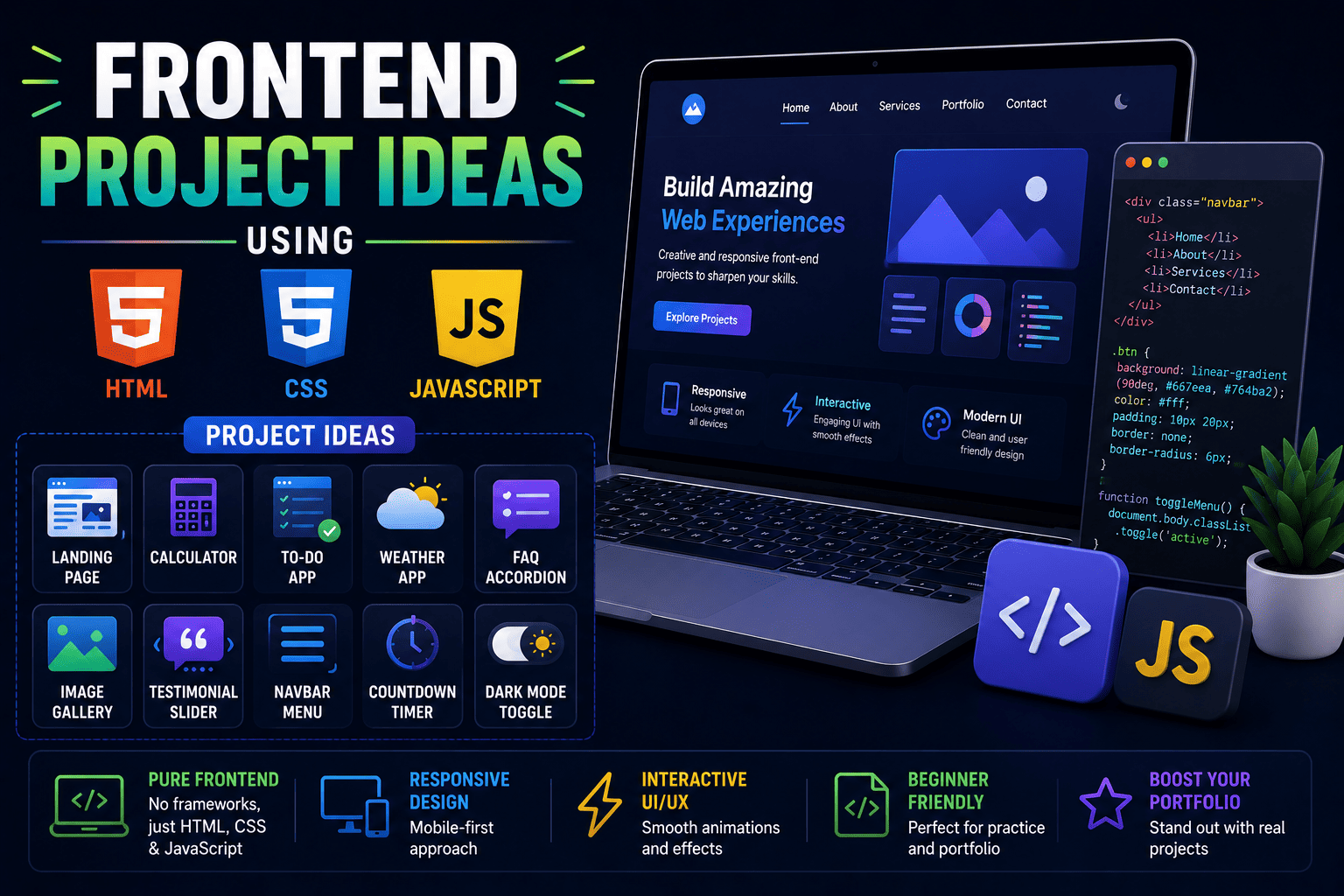
Frontend Project Ideas Using HTML, CSS & JavaScript
Imagine learning HTML, CSS, and JavaScript for weeks.
You understand the basics.
You know how to create pages, style elements, and add interactivity.
But then someone asks:
“What have you built?”
Many students suddenly realize that watching tutorials and reading notes is not enough.
Employers, internship recruiters, and freelance clients want to see real projects.
That’s where frontend projects become important.
Projects help you apply concepts, solve problems, and build confidence as a developer.
Whether you’re a student of 11th & 12th, BA, BCA, BSc, B.Com, or B.Tech, building frontend projects is one of the fastest ways to improve your skills and prepare for a successful career in web development.
In this guide, you’ll discover practical frontend project ideas using HTML, CSS & JavaScript that can strengthen your portfolio and help you stand out from other beginners.
Why Frontend Projects Matter for Students
Many students focus only on learning concepts.
However, web development is a practical skill.
You learn the most when you actually build something.
Frontend projects help you:
- Apply theoretical knowledge
- Improve coding skills
- Understand real-world development
- Build a portfolio
- Gain confidence
- Prepare for internships and jobs
Projects also reveal knowledge gaps that tutorials often hide.
When you build projects, you learn how different concepts work together.
What Makes a Good Frontend Project?
Not every project provides the same learning experience.
The best projects allow you to practice:
- HTML structure
- CSS styling
- Responsive design
- JavaScript functionality
- User experience principles
- Problem-solving skills
A good project should challenge you without becoming overwhelming.
The goal is continuous improvement.
15 Powerful Frontend Project Ideas for Beginners
1. Personal Portfolio Website
A portfolio website is often the first project every web developer should build.
Skills practiced:
- Layout design
- Responsive design
- Navigation menus
- Contact forms
This project can also become part of your professional portfolio.
2. Student Resume Website
Instead of sending a traditional resume, create a website that showcases your:
- Education
- Skills
- Projects
- Achievements
This helps students practice both design and content organization.
3. Landing Page Design
Landing pages are commonly used by businesses to promote products and services.
What you’ll learn:
- Call-to-action sections
- Visual hierarchy
- Conversion-focused design
Many freelance projects involve creating landing pages.
4. To-Do List Application
This classic JavaScript project remains one of the best beginner exercises.
Features can include:
- Add tasks
- Delete tasks
- Mark tasks as complete
- Save tasks locally
You’ll learn DOM manipulation and event handling.
5. Calculator Application
A calculator project helps strengthen JavaScript fundamentals.
Skills practiced:
- Functions
- User input handling
- Mathematical operations
- UI development
Although simple, it demonstrates logical thinking.
6. Weather Application
Using a weather API makes this project more realistic.
Students learn:
- API integration
- Data fetching
- Dynamic content updates
- Error handling
This project introduces concepts used in modern web applications.
7. Quiz Application
An interactive quiz application is excellent for practicing JavaScript.
Possible features:
- Multiple questions
- Score tracking
- Timer functionality
- Results page
This project improves logic-building skills.
8. Restaurant Website
Restaurant websites are common freelance projects.
Pages can include:
- Home
- Menu
- About
- Contact
This project teaches website structure and responsive design.
9. Image Gallery
An image gallery helps students understand visual presentation.
Features may include:
- Filters
- Lightbox effect
- Categories
- Responsive layouts
This project focuses heavily on CSS and user experience.
10. Expense Tracker
An expense tracker helps users manage daily spending.
Students practice:
- Data entry
- Calculations
- Local storage
- Dashboard creation
This project combines design and functionality effectively.
11. Movie Search Application
This project uses external APIs to display movie information.
Skills developed:
- API requests
- Search functionality
- Dynamic UI updates
- Data management
Recruiters often appreciate projects involving real data.
12. Digital Clock
A digital clock may seem simple, but it teaches important JavaScript concepts.
Topics covered:
- Date and time functions
- Intervals
- Real-time updates
It’s a great beginner-friendly project.
13. Event Registration Website
Event websites are useful for schools, colleges, and organizations.
Features can include:
- Event details
- Registration form
- Schedule section
- Contact information
This project has real-world business relevance.
14. Blog Website Interface
A blog project helps students understand content-focused design.
Key areas practiced:
- Layout structure
- Typography
- Navigation
- User readability
Many businesses and creators need blog websites.
15. Interactive Educational Website
Create a website that teaches a topic.
Examples include:
- Science concepts
- Programming tutorials
- Mathematics lessons
- Exam preparation content
Educational websites combine creativity and functionality.
Project Difficulty Comparison
| Project Type | Difficulty Level | Portfolio Value |
|---|---|---|
| Portfolio Website | Beginner | High |
| Calculator | Beginner | Medium |
| Quiz Application | Beginner | Medium |
| Restaurant Website | Beginner | High |
| Weather Application | Intermediate | High |
| Expense Tracker | Intermediate | High |
| Movie Search App | Intermediate | High |
| Educational Website | Intermediate | High |
Projects with real-world applications generally provide stronger portfolio value.
How to Choose the Right Frontend Project
Many students try to build projects that are too complex.
This often leads to frustration.
Choose projects based on:
- Current skill level
- Learning goals
- Available time
- Portfolio requirements
Start simple and gradually increase complexity.
Consistency matters more than difficulty.
How These Projects Help Your Career
Frontend projects do much more than improve coding skills.
They help students:
- Build professional portfolios
- Demonstrate practical experience
- Prepare for internships
- Attract freelance opportunities
- Improve problem-solving abilities
Many recruiters care more about projects than certificates because projects provide evidence of actual skills.
Why Learning Through Projects Is Important
Reading tutorials helps you understand concepts.
Building projects helps you master them.
Projects teach:
- Debugging
- Critical thinking
- User-focused design
- Practical implementation
- Project management
These skills are essential in real-world development environments.
How SiteGenius Helps Students Build Industry-Ready Projects
Many students struggle because they learn theory without creating meaningful projects.
The SiteGenius Web Development Training Program focuses on hands-on learning, practical project development, and portfolio building.
Students learn:
- HTML, CSS and JavaScript fundamentals
- Responsive website design
- WordPress website development
- SEO basics
- GitHub project management
- Real-world project implementation
Instead of only learning concepts, students create projects that can be showcased in portfolios and job applications.
This practical approach helps students become more confident and career-ready.
You can:
- Explore the curriculum page to see skill modules
- Visit the admission page for batch details
- Attend the free Awareness session
FAQs- Frontend Project Ideas Using HTML CSS & JavaScript
Which frontend project is best for beginners?
A portfolio website, calculator, or to-do list application are excellent beginner projects because they cover essential frontend development concepts.
Do recruiters care about frontend projects?
Yes. Recruiters often evaluate projects to understand your practical skills, problem-solving ability, and coding experience.
How many frontend projects should I include in my portfolio?
A portfolio with 5-10 quality projects is usually sufficient for students and beginner developers.
Can HTML, CSS, and JavaScript projects help me get internships?
Absolutely. Strong projects demonstrate practical skills and can significantly improve your chances of securing internships.
Should I upload my projects to GitHub?
Yes. GitHub allows recruiters and employers to review your code, development process, and technical abilities.
Conclusion
Building frontend projects using HTML, CSS & JavaScript is one of the smartest ways to accelerate your learning.
Projects transform theory into practical skills.
They help you understand development, build confidence, and create a portfolio that demonstrates your abilities.
Start small.
Build consistently.
Learn from every project.
Keep improving your skills.
The projects you build today could become the foundation of your future web development career.