
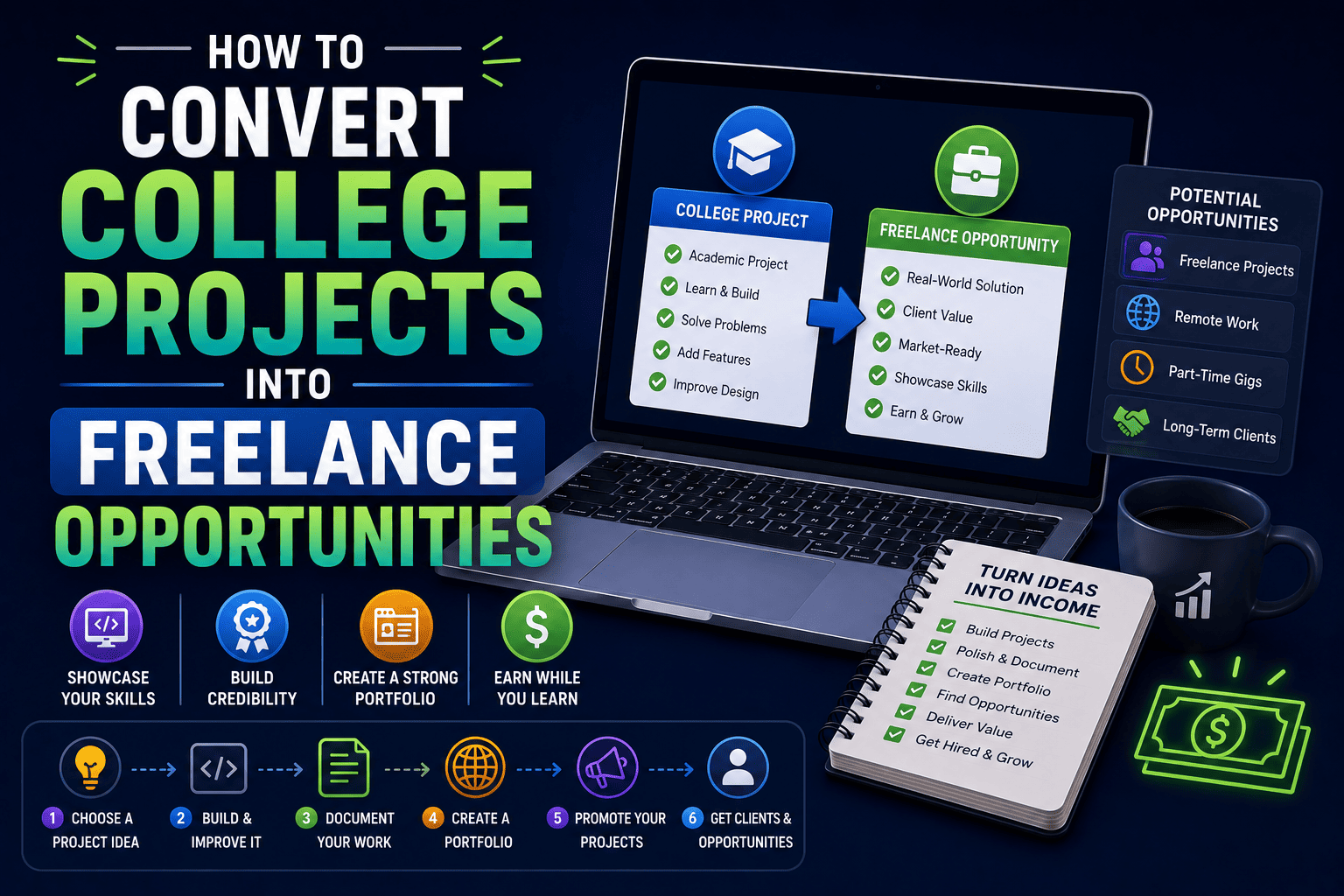
How to Convert College Projects into Freelance Opportunities
Have you ever completed a college web development project and wondered:
“Can I actually earn money using this skill?”
The answer is yes.
Many successful freelancers started with nothing more than a few college projects, a willingness to learn, and the confidence to showcase their work.
The problem is that most students treat college projects as assignments.
They complete them, submit them, receive grades, and move on.
But smart students view projects differently.
They see them as portfolio assets, learning opportunities, and even potential income sources.
Whether you’re studying in 11th & 12th, BA, BCA, BSc, B.Com, or B.Tech, learning how to convert college projects into freelance opportunities can help you gain experience, build confidence, and even start earning before graduation.
In this guide, you’ll learn practical strategies to transform your projects into real freelance opportunities.
Why College Projects Are More Valuable Than You Think
Many students underestimate the value of their projects.
A project isn’t just an academic requirement.
It’s proof that you can:
- Build websites
- Solve problems
- Apply technical skills
- Complete a task from start to finish
These are exactly the qualities clients look for when hiring freelancers.
Even simple projects can demonstrate valuable skills.
For example:
| College Project | Potential Freelance Service |
|---|---|
| Restaurant Website | Website creation for local restaurants |
| Portfolio Website | Personal branding websites |
| Event Management Portal | Event registration websites |
| Blog Website | Content publishing websites |
| E-commerce Project | Online store development |
The key is learning how to present your projects professionally.
Understanding What Clients Actually Want
Many beginners believe clients want complex applications.
In reality, most small businesses need straightforward solutions.
Clients often need:
- Business websites
- Landing pages
- Portfolio websites
- Blog websites
- WordPress websites
- Website maintenance
- Website redesign services
A project you built for college may already solve a problem similar to what a client needs.
The challenge is learning how to position your work effectively.
Step-by-Step Guide to Convert College Projects into Freelance Opportunities
Step 1: Turn Every Project into a Portfolio Piece
Don’t leave your projects sitting on your computer.
Create a professional presentation for each project.
Include:
- Project title
- Project objective
- Technologies used
- Key features
- Screenshots
- Live project link
- GitHub repository
A well-documented project looks far more professional than a folder full of code.
Recruiters and clients both appreciate clear presentation.
Step 2: Host Your Projects Online
Clients want to see working websites.
Static screenshots are helpful, but live projects are much more convincing.
Popular hosting platforms include:
- GitHub Pages
- Netlify
- Vercel
When clients can interact with your project themselves, they gain confidence in your abilities.
A live project instantly makes your work feel more professional.
Step 3: Create a Personal Portfolio Website
Your portfolio website acts as your digital office.
It’s where potential clients evaluate your skills.
Essential sections should include:
- Home
- About
- Services
- Projects
- Skills
- Contact
A clean and professional portfolio demonstrates your attention to detail and web design capabilities.
Step 4: Identify Real Problems Your Projects Solve
Clients don’t buy websites.
They buy solutions.
Instead of saying:
“I built a restaurant website.”
Say:
“This website helps restaurants showcase menus, attract customers, and receive booking inquiries online.”
This shift in presentation makes your projects far more attractive to potential clients.
Focus on the problem solved, not just the technology used.
Step 5: Build Industry-Relevant Projects
Some project types attract freelance opportunities more easily.
Examples include:
Business Websites: Small businesses constantly need websites.
Portfolio Websites: Professionals often need personal branding websites.
Blog Websites: Content creators and businesses require blogging platforms.
Event Websites: Schools, colleges, and organizations frequently host events.
E-commerce Websites: Many local businesses want to sell products online.
Projects related to these industries can become excellent portfolio assets.
Step 6: Learn Basic Client Communication
Technical skills alone are not enough.
Freelancers also need communication skills.
Practice explaining:
- Project goals
- Features
- Timelines
- Website benefits
- Maintenance requirements
The ability to explain technical concepts in simple language is a valuable professional skill.
Step 7: Use Social Proof Whenever Possible
People trust work that others have already appreciated.
Social proof can include:
- Positive feedback from teachers
- Testimonials from classmates
- Project competition awards
- Internship recommendations
Even small achievements can strengthen your credibility.
Step 8: Offer Your Skills Locally First
Many students focus immediately on global freelancing platforms.
A simpler approach is to start nearby.
Consider helping:
- Local shops
- Coaching centers
- Restaurants
- Tutors
- Small businesses
These businesses often need websites but may not know where to find affordable developers.
Local projects can help you build confidence and gain experience.
Step 9: Build a Strong GitHub Profile
GitHub acts as proof of your development journey.
Clients and recruiters often review GitHub repositories before making decisions.
A strong GitHub profile should show:
- Organized repositories
- Consistent activity
- Clear documentation
- Meaningful project descriptions
Even beginner projects can create a positive impression when presented professionally.
Step 10: Continue Improving Every Project
Your first version doesn’t need to be perfect.
The most successful freelancers continuously improve their work.
Regular improvements may include:
- Better design
- Faster performance
- Mobile responsiveness
- New features
- Improved user experience
Every update makes your portfolio stronger and increases your market value.
Common Mistakes Students Make When Seeking Freelance Work
Many beginners unintentionally reduce their chances of getting clients.
Avoid these mistakes:
- Keeping projects offline
- Using unfinished projects
- Ignoring mobile responsiveness
- Poor project descriptions
- No portfolio website
- No GitHub profile
- Waiting until graduation to start
Starting early gives you a significant advantage.
Portfolio Comparison: Which Student Is More Likely to Get Freelance Work?
| Student A | Student B |
|---|---|
| Completes projects for grades only | Builds projects and showcases them online |
| No portfolio website | Professional portfolio website |
| No GitHub profile | Active GitHub profile |
| No live projects | Live project demonstrations |
| Waits for opportunities | Actively markets skills |
Most clients and recruiters naturally prefer Student B because there is clear evidence of practical skills.
Why Learning Freelancing Skills Matters
Freelancing offers benefits beyond earning money.
Students develop:
- Communication skills
- Client management skills
- Problem-solving ability
- Business understanding
- Professional confidence
These experiences can strengthen future job applications and interviews.
Many successful web developers began their careers through freelance work.
How SiteGenius Helps Students Build Freelance-Ready Skills
Many students struggle because they learn theory but rarely build practical projects.
The SiteGenius Web Development Training Program emphasizes hands-on learning, portfolio development, and real-world implementation.
Students learn:
- HTML, CSS and JavaScript fundamentals
- WordPress website development
- Responsive website design
- SEO basics
- GitHub project management
- Practical project building
Instead of focusing only on theory, students create projects that can be showcased to recruiters and potential clients.
This practical approach helps students become more confident and industry-ready.
You can:
- Explore the curriculum page to see skill modules
- Visit the admission page for batch details
- Attend the free Awareness session
FAQs- Convert College Projects into Freelance Opportunities
Can college projects really help me get freelance clients?
Yes. Well-presented projects demonstrate your skills and can convince clients that you’re capable of solving real problems.
How many projects should I have before starting freelancing?
A portfolio with 5-10 strong projects is usually enough to start attracting opportunities.
Do I need professional experience before freelancing?
No. Many students begin freelancing using personal projects, college projects, and portfolio websites.
Should I upload my projects to GitHub?
Absolutely. A strong GitHub profile helps showcase your coding skills and development process.
What type of projects attract freelance clients most often?
Business websites, portfolio websites, WordPress websites, blogs, and e-commerce projects are among the most commonly requested services.
Conclusion
Learning how to convert college projects into freelance opportunities can significantly accelerate your career growth.
Every project you build has the potential to become more than an assignment.
It can become a portfolio piece, a learning experience, and even a source of income.
Build meaningful projects.
Showcase them professionally.
Solve real problems.
Keep improving continuously.
The students who start early often gain experience, confidence, and opportunities long before graduation.