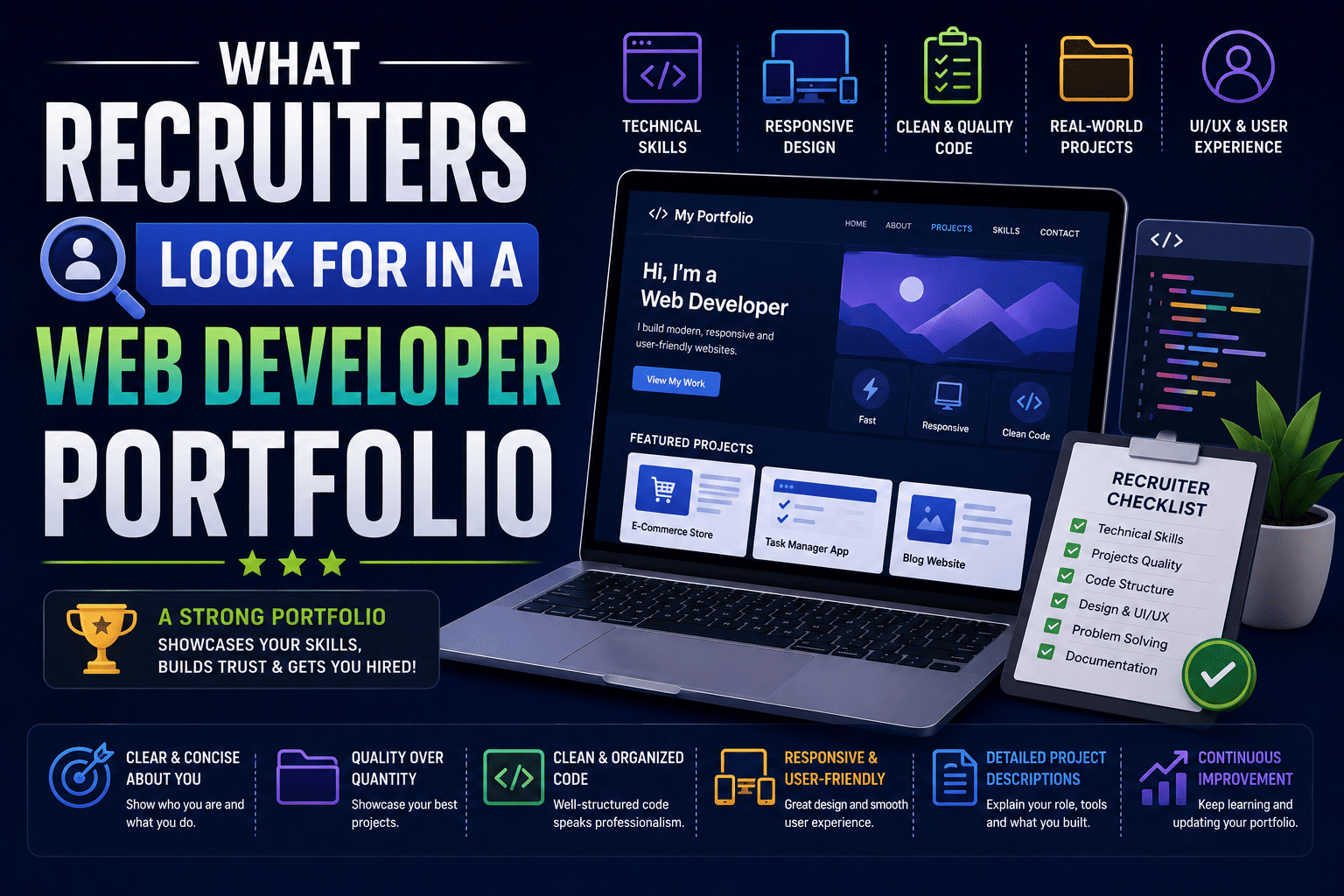
What Recruiters Look for in a Web Developer Portfolio
Imagine you’ve applied for your dream internship.
A recruiter opens your resume and notices a link to your portfolio website.
Within a few seconds, they start judging your skills.
Not based on your marks.
Not based on your college.
Not based on the number of certificates you have.
They’re looking at your portfolio.
This is exactly why a strong portfolio can become one of the most valuable career assets for aspiring web developers.
Many students believe recruiters expect advanced coding skills or years of experience.
The reality is often much simpler.
Recruiters want evidence that you can learn, build, solve problems, and create useful websites.
Whether you’re studying in 11th & 12th, BA, BCA, BSc, B.Com, or B.Tech, understanding what recruiters look for in a web developer portfolio can help you create a portfolio that stands out from the competition.
In this guide, you’ll learn the key elements recruiters value and how to build a portfolio that improves your chances of landing internships and job opportunities.
Why Your Portfolio Matters More Than You Think
A resume tells recruiters what you’ve learned.
A portfolio shows recruiters what you’ve actually built.
That’s a major difference.
Many students claim they know:
- HTML
- CSS
- JavaScript
- WordPress
- Bootstrap
But recruiters want proof.
A portfolio provides that proof through real projects and practical work.
A strong portfolio helps you:
- Demonstrate technical skills
- Showcase creativity
- Build credibility
- Stand out from other applicants
- Improve internship opportunities
- Create a professional online presence
For many entry-level roles, a portfolio can be more influential than grades alone.
What Is a Web Developer Portfolio?
A web developer portfolio is a website that showcases your:
- Projects
- Skills
- Experience
- Resume
- Certifications
- Contact information
Think of it as your personal digital showroom.
It gives recruiters a quick way to evaluate your capabilities and potential.
The Top Things Recruiters Look for in a Web Developer Portfolio
1. Real Projects Instead of Just Tutorials
One of the first things recruiters notice is the quality of your projects.
Many students simply follow YouTube tutorials and upload identical projects.
Recruiters can often recognize these immediately.
Instead, they prefer projects that:
- Solve real problems
- Show creativity
- Demonstrate independent thinking
- Include custom features
For example:
- College event management website
- Restaurant booking system
- Student attendance portal
- Portfolio website
- Online quiz application
Real-world projects leave a stronger impression.
2. A Clean and Professional Design
Your portfolio itself is a project.
If your portfolio looks confusing or outdated, recruiters may assume your design skills need improvement.
A professional portfolio should have:
- Simple navigation
- Clean layout
- Readable typography
- Consistent styling
- Fast loading speed
Remember, simplicity often looks more professional than excessive animations and effects.
3. Mobile-Friendly Design
Today, many recruiters review portfolios on mobile devices.
A website that works perfectly on desktop but breaks on smartphones creates a poor user experience.
Recruiters expect:
- Responsive layouts
- Mobile-friendly navigation
- Proper image scaling
- Fast mobile performance
Responsive design is considered a basic skill for modern web developers.
4. Strong Project Descriptions
Many students upload projects without explaining them.
This is a missed opportunity.
Recruiters want to understand:
- What the project does
- Why it was built
- Which technologies were used
- What challenges were solved
Example of a strong description:
“This student management system was built using HTML, CSS, JavaScript, PHP, and MySQL. It allows administrators to manage student records and generate reports efficiently.”
Detailed project descriptions demonstrate technical understanding.
5. Live Project Links
Screenshots are useful.
Live websites are better.
Recruiters appreciate being able to interact with your projects.
Popular platforms for hosting projects include:
- GitHub Pages
- Netlify
- Vercel
Live demonstrations build trust and credibility.
6. GitHub Profile Integration
Many recruiters check GitHub profiles to evaluate coding practices.
A GitHub profile demonstrates:
- Code organization
- Development consistency
- Project history
- Technical skills
Your GitHub profile should include:
- Organized repositories
- Meaningful project names
- Clear documentation
- Regular activity
Even beginner projects can create a positive impression.
7. Evidence of Continuous Learning
Technology evolves quickly.
Recruiters value students who continuously improve their skills.
Ways to demonstrate growth include:
- Adding new projects
- Learning new technologies
- Updating portfolio content
- Completing practical challenges
- Improving previous work
A portfolio that evolves over time reflects commitment and dedication.
8. Clear Contact Information
This sounds simple, but many students forget it.
Recruiters should be able to contact you easily.
Include:
- Email address
- LinkedIn profile
- GitHub profile
- Contact form
Missing contact information can cost valuable opportunities.
9. Problem-Solving Ability
Recruiters are not only evaluating websites.
They are evaluating how you think.
Projects that solve practical problems demonstrate:
- Critical thinking
- Creativity
- Technical understanding
- Initiative
Problem-solving ability often matters more than complex visual effects.
10. Professional Presentation
A portfolio should feel complete and polished.
Professional portfolios typically include:
- Home page
- About page
- Projects page
- Skills section
- Resume section
- Contact page
Attention to detail can significantly improve recruiter perception.
What Recruiters Don't Want to See
Understanding what to avoid is equally important.
Common portfolio mistakes include:
- Broken links
- Unfinished projects
- Poor design
- Copy-pasted content
- Missing descriptions
- Slow loading websites
- No contact details
Even strong projects can lose impact if the presentation is poor.
Portfolio Comparison: What Stands Out More?
| Portfolio A | Portfolio B |
|---|---|
| Tutorial projects only | Real-world projects |
| No GitHub links | GitHub repositories included |
| Basic screenshots | Live project demonstrations |
| Limited descriptions | Detailed project explanations |
| Rarely updated | Regularly improved |
Recruiters generally prefer Portfolio B because it provides stronger evidence of practical skills.
How Many Projects Should a Student Portfolio Have?
Many students think they need dozens of projects.
That’s not true.
A portfolio with 5-10 high-quality projects is usually enough.
Focus on:
- Quality over quantity
- Variety of projects
- Practical applications
- Clean presentation
A few strong projects are far more effective than many unfinished ones.
Why Building a Strong Portfolio Matters for Your Career
A portfolio can help students:
- Secure internships
- Gain freelance clients
- Improve interview performance
- Build personal branding
- Demonstrate practical experience
In a competitive job market, portfolios often become a deciding factor.
Recruiters want proof that you can create value.
A strong portfolio provides exactly that.
Why Portfolio Building Is a Valuable Skill
Building a portfolio teaches more than web development.
Students also learn:
- Personal branding
- Project management
- Communication
- User experience design
- Problem-solving
- Professional presentation
These skills remain valuable throughout a career.
How SiteGenius Helps Students Build Recruiter-Ready Portfolios
Many students struggle because they learn theory without building practical projects.
The SiteGenius Web Development Training Program focuses on hands-on learning and portfolio development.
Students learn:
- HTML, CSS and JavaScript fundamentals
- WordPress website development
- Responsive website design
- SEO basics
- GitHub project management
- Real-world project implementation
Instead of simply studying concepts, students build projects that can be showcased in professional portfolios.
This practical approach helps students become more confident, skilled, and career-ready.
You can:
- Explore the curriculum page to see skill modules
- Visit the admission page for batch details
- Attend the free Awareness session
FAQs- What Recruiters Look for in a Web Developer Portfolio
What is the most important part of a web developer portfolio?
The most important part is showcasing real projects that demonstrate your practical skills and problem-solving abilities.
Do recruiters check GitHub profiles?
Yes. Many recruiters review GitHub repositories to understand coding practices, project quality, and technical skills.
How many projects should a student portfolio include?
Most students should aim for 5-10 quality projects rather than a large number of unfinished projects.
Can beginners create a strong portfolio?
Absolutely. Even beginner-level projects can create a strong impression when they are well-designed and properly documented.
Should I include certificates in my portfolio?
Yes, but projects should remain the primary focus. Recruiters usually value practical work more than certificates alone.
Conclusion
Understanding what recruiters look for in a web developer portfolio can give students a significant advantage.
Recruiters want more than claims.
They want proof.
Build real projects.
Create a professional portfolio website.
Showcase your work on GitHub.
Keep learning and improving.
Remember, your portfolio is not just a collection of websites.
It is a reflection of your skills, effort, and potential as a future web developer.
The stronger your portfolio becomes, the more opportunities you create for yourself.