
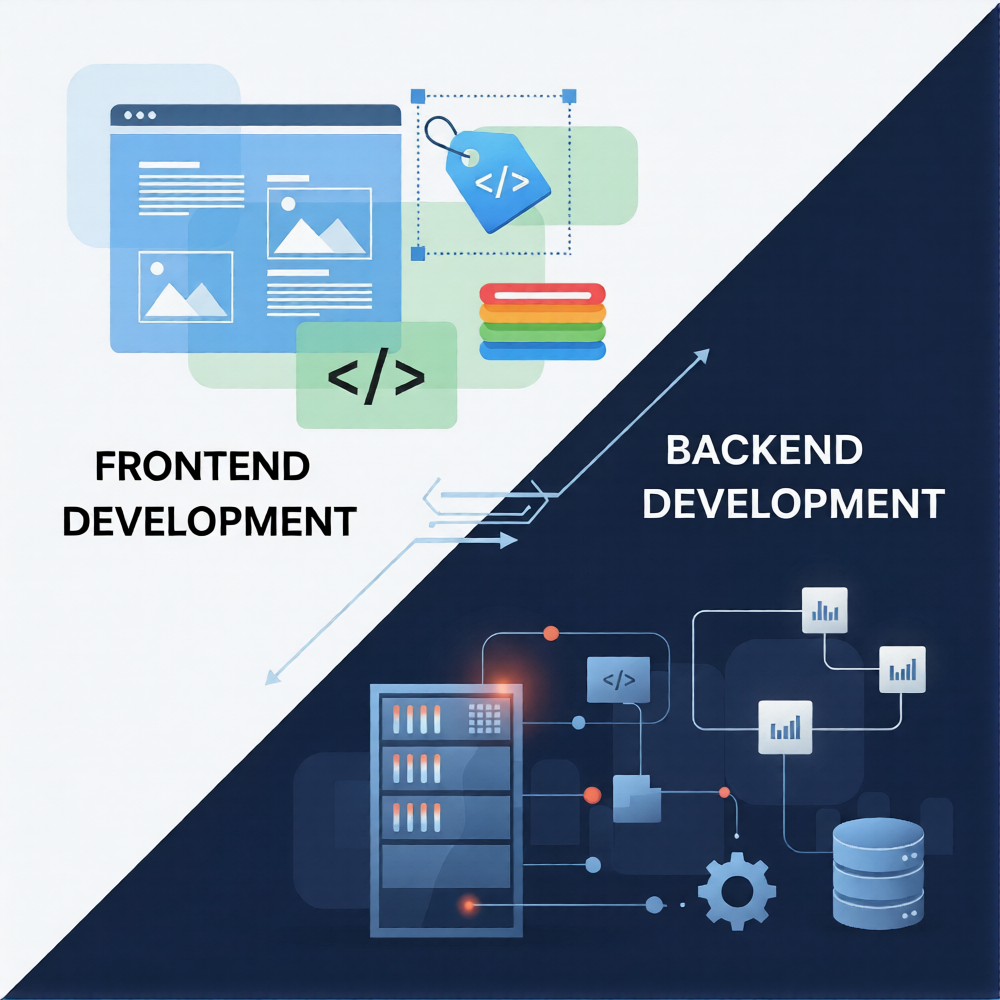
Frontend vs Backend Development: What’s the Difference?
Two Sides of Every Website
When you open a website, everything looks simple.
You see:
- Images
- Buttons
- Text
- Forms
- Navigation menus
But behind this simple interface lies two major parts of web development:
Frontend development and Backend development.
These two work together to make websites function smoothly.
For students exploring web development, understanding this difference is one of the first important steps in the learning journey.
In this beginner-friendly guide, you will learn:
- What frontend development is
- What backend development is
- The key differences between Frontend vs Backend Development
- Which one beginners should start with
- How students can build a career in web development
What Is Frontend Development?
Frontend development refers to the part of a website that users see and interact with.
It focuses on the visual and interactive side of websites.
Frontend developers create things like:
- Website layouts
- Navigation menus
- Buttons
- Animations
- Responsive design
In simple words:
Frontend development controls how a website looks and feels.
Imagine you open an online clothing store.
You see:
- Product images
- Add to cart buttons
- Search bar
- Category menu
All of these are built by frontend developers.
Technologies Used in Frontend Development
HTML
HTML creates the structure of a webpage.
It defines elements like:
- Headings
- Paragraphs
- Images
- Forms
CSS
CSS controls design and appearance.
It handles things like:
- Colors
- Layouts
- Fonts
- Spacing
- Mobile responsiveness
JavaScript
JavaScript adds interactivity.
Examples include:
- Dropdown menus
- Image sliders
- Form validation
- Dynamic content updates
What Is Backend Development?
Backend development focuses on the behind-the-scenes functionality of a website.
It handles:
- Data processing
- Server communication
- User authentication
- Database management
In simple terms:
Backend development controls how a website works internally.
Users don’t see backend code, but it powers the entire system.
Example:
Imagine you create an account on a website.
You enter:
- Name
- Password
The backend handles:
- Storing your data
- Checking login credentials
- Managing user accounts
Without backend development, websites would not be able to process user actions.
Technologies Used in Backend Development
Backend developers use different programming tools.
Some common backend technologies include:
Server-Side Languages
Examples:
- PHP
- Python
- JavaScript (Node.js)
These languages process user requests.
Databases
Databases store information such as:
- User profiles
- Orders
- Messages
- Website content
Examples include:
- MySQL
- MongoDB
Servers
Servers host the website and deliver data when users request it.
Frontend vs Backend Development:
Key Differences
Here is a simple comparison table.
| Feature | Frontend Development | Backend Development |
|---|---|---|
| Focus | Website Design and Interface | Website Functionality |
| Visibility | Visible to Users | Hidden from Users |
| Main Role | User Experience | Data Processing |
| Languages | HTML, CSS, JavaScript | PHP, Python, Node.js |
| Work Area | Browser | Server |
Both are essential for building modern websites.
How Frontend and Backend Work Together
Frontend and backend developers collaborate closely.
Let’s look at a simple example.
Example: Online Login
Step 1
User enters email and password (Frontend)
Step 2
Data is sent to the server (Backend)
Step 3
Backend checks database
Step 4
Server sends response
Step 5
Frontend displays login success or error message
This teamwork creates smooth digital experiences.
What Is Full Stack Development?
Some developers choose to learn both frontend and backend development.
These professionals are called Full Stack Developers.
They can:
- Design user interfaces
- Write backend logic
- Manage databases
- Deploy websites
Full stack developers are highly valuable because they understand the entire system of a website.
Which Is Better for Beginners: Frontend or Backend?
For beginners, frontend development is usually easier to start with.
Reasons include:
- Immediate visual results
- Simpler concepts at the beginning
- Faster learning curve
When you build a webpage using HTML and CSS, you can instantly see your work in a browser.
This makes learning more engaging for students.
After gaining frontend skills, beginners can gradually explore backend development.
Career Opportunities in Frontend and Backend Development
Both fields offer excellent career paths.
Frontend Developer Roles
Frontend developers focus on user interfaces.
Common roles include:
- Frontend Developer
- UI Developer
- Web Designer
- JavaScript Developer
Backend Developer Roles
Backend developers handle server logic.
Common roles include:
- Backend Developer
- API Developer
- Database Developer
- Server Engineer
Full Stack Developer
Full stack developers work on both sides of web development.
This role is highly demanded in startups and technology companies.
Why Learning Web Development Skills Matters Today
India’s digital economy is expanding rapidly.
Every business today needs an online presence.
Examples include:
- Online stores
- Educational websites
- Service platforms
- Startup applications
Because of this growth, companies constantly look for skilled developers.
Learning web development helps students:
- Build job-ready skills
- Start freelancing
- Work remotely
- Create their own websites or startups
For students seeking skill-based careers, web development is a strong option.
How the SiteGenius Program Helps Beginners Learn Web Development
Many beginners feel overwhelmed because they try to learn from random tutorials.
A structured learning program can make the journey easier.
The SiteGenius Web Development Training Program is designed specifically for beginners who want to build real skills.
Students learn:
- Web development fundamentals
- Frontend technologies step by step
- Backend concepts and server logic
- Practical project development
- Portfolio building
If you want to explore further:
- Visit the Curriculum Page to see complete roadmap
- Check the Admission Page for upcoming batches
- Attend the Free Awareness Session
FAQs: Frontend vs Backend Development
1. What is the main difference between frontend and backend development?
Frontend development focuses on what users see and interact with, while backend development manages the server, database, and application logic.
2. Which is easier to learn for beginners?
Frontend development is usually easier for beginners because it involves visual design and simpler coding concepts.
3. Can one person learn both frontend and backend?
Yes. Developers who learn both are called Full Stack Developers, and they are highly valued in the tech industry.
4. Do I need a computer science degree to become a web developer?
No. Many successful developers come from arts, commerce, or science backgrounds and learn through skill-based training.
5. Is web development a good career in India?
Yes. With the rapid growth of digital businesses, startups, and online services, web development is one of the most promising IT careers in India.
Conclusion: Choose Your Path and Start Building
Frontend and backend development are two powerful parts of the same system.
Frontend creates the visual experience, while backend ensures everything works correctly behind the scenes.
Together, they build the websites and applications we use every day.
For students interested in technology, web development offers:
- Exciting career opportunities
- Practical skill-based learning
- Freelancing and remote work options
- Long-term growth in the IT industry
The most important step is getting started with the right guidance and structured learning.
If you want to move from curiosity to real skills, exploring the SiteGenius Web Development Training Program can help you begin your journey toward becoming a professional web developer.
Every expert developer once started as a beginner – and your journey can start today.