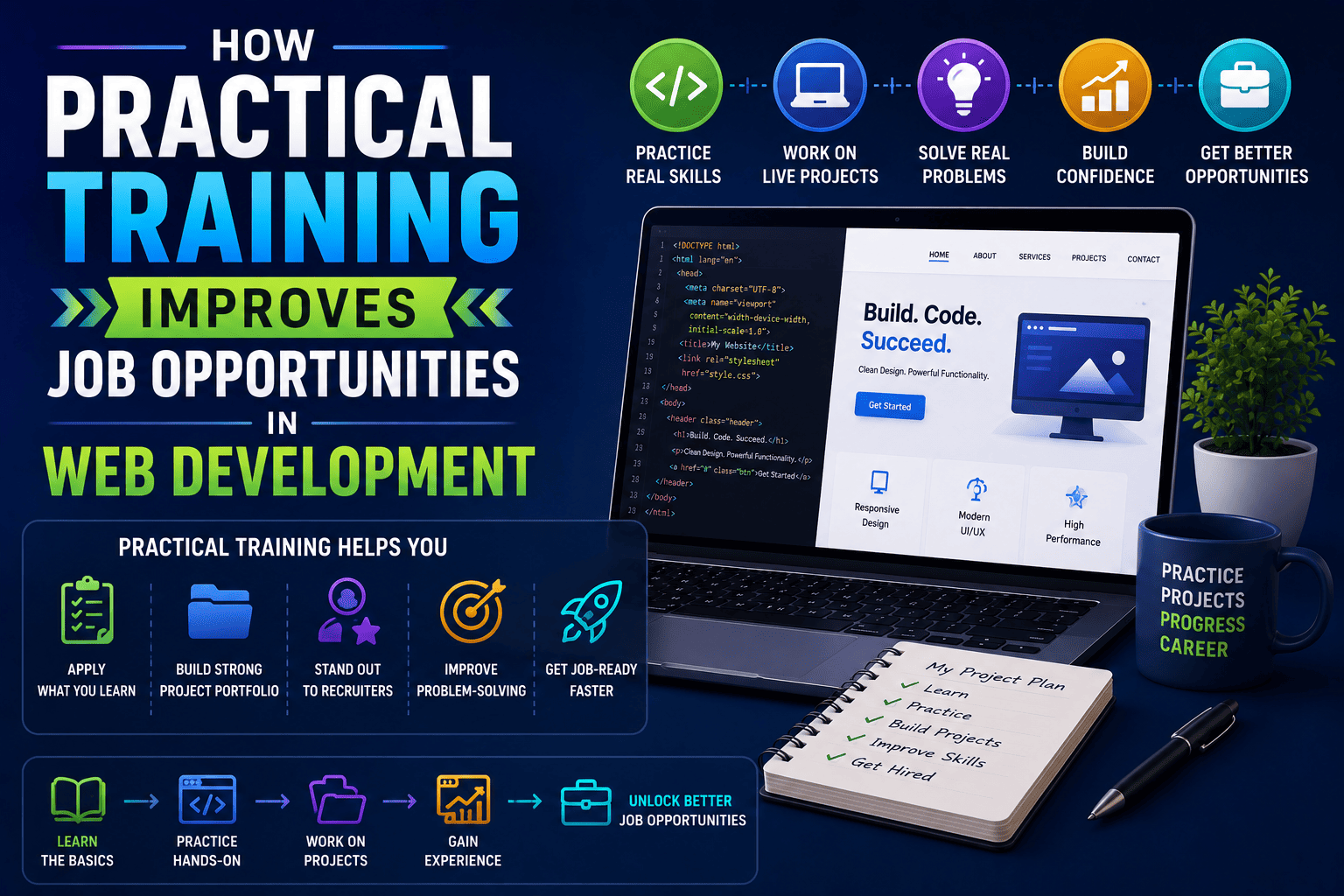
How Practical Training Improves Job Opportunities in Web Development
Why Skills Matter More Than Ever
Imagine two students applying for the same web development internship.
The first student has completed several online tutorials and knows the theory behind website development.
The second student has built a portfolio website, created a business website, optimized a WordPress site, and presented real projects during interviews.
Who do you think gets noticed first?
In most cases, employers choose the student who can demonstrate practical skills.
Today’s web development industry is highly competitive. Companies want candidates who can contribute from day one. They are not only interested in certificates or theoretical knowledge. They want proof that a candidate can solve real problems and build real websites.
This is why Web Development Training that focuses on hands-on projects and real-world experience has become one of the most important factors in improving job opportunities in web development.
Whether you are a student of 11th or 12th, pursuing a BA, BCA, BSc, B.Com, or B.Tech degree, practical experience gained through Web Development Training can significantly increase your chances of landing internships, freelance projects, and full-time jobs.
What Is Practical Training in Web Development?
Practical training refers to learning by doing rather than only reading or watching tutorials.
Instead of simply learning concepts, students apply those concepts by building actual websites and completing projects.
Examples of practical training include:
- Creating portfolio websites
- Building business websites
- Developing WordPress projects
- Designing responsive web pages
- Working with website hosting and domains
- Optimizing website speed and SEO
- Presenting projects and receiving feedback
- Solving real-world website issues
Practical training transforms knowledge into skills that employers can evaluate.
Why Employers Prefer Practically Trained Candidates
Many students assume that completing a course is enough to get hired.
However, recruiters often ask questions such as:
- What projects have you built?
- Can you show your portfolio?
- Have you worked on a live website?
- How did you solve a technical problem in your project?
These questions focus on practical experience.
What Employers Really Look For
| Theory-Based Candidate | Practically Trained Candidate |
|---|---|
| Knows concepts | Applies concepts |
| Has certificates | Has projects |
| Limited problem-solving experience | Demonstrates problem-solving ability |
| Difficult to assess skills | Easy to assess skills |
| Less confidence in interviews | More confidence in interviews |
Practical training provides evidence of capability, making candidates more attractive to employers.
How Practical Training Improves Job Opportunities
1. Helps You Build a Strong Portfolio
A portfolio is often more powerful than a resume in web development.
When recruiters see live projects, they gain confidence in your abilities.
For example:
A BCA student who creates:
- A personal portfolio website
- A restaurant website
- A blog website
- A small business website
will stand out significantly compared to someone who only lists skills on a resume.
Your portfolio becomes proof of your expertise.
2. Develops Real-World Problem-Solving Skills
Real projects rarely go exactly as planned.
Students encounter challenges such as:
- Layout issues
- Mobile responsiveness problems
- Plugin conflicts
- Slow-loading pages
- Navigation errors
- SEO optimization challenges
Learning how to solve these problems prepares students for professional work environments.
Employers value problem solvers because real-world projects require continuous troubleshooting.
3. Improves Confidence During Interviews
One of the biggest advantages of practical training is confidence.
Students who have built multiple projects can confidently explain:
- Their development process
- Design decisions
- Challenges faced
- Solutions implemented
- Lessons learned
Instead of giving theoretical answers, they can discuss actual experiences.
This creates a much stronger impression during interviews.
4. Makes You Internship-Ready
Many companies prefer interns who already understand the basics of website creation.
Practical training helps students:
- Work with WordPress
- Understand hosting environments
- Create responsive websites
- Use SEO tools
- Manage website content
As a result, they require less supervision and can contribute more quickly.
This increases internship opportunities significantly.
5. Opens Freelancing Opportunities
Practical skills don’t just help with jobs.
They also create income opportunities.
Students can begin offering services such as:
- Website design
- WordPress development
- Website maintenance
- SEO optimization
- Landing page creation
Even small freelance projects help build experience and confidence.
Many successful web developers started by working on small projects for local businesses, friends, or community organizations.
6. Demonstrates Industry Readiness
Companies want candidates who understand modern web development practices.
Practical training introduces students to:
- Website structure
- User experience principles
- Responsive design
- Performance optimization
- SEO fundamentals
- Content management systems
These skills make students industry-ready rather than just academically prepared.
A Simple Example: Theory vs Practical Learning
Consider two students learning WordPress.
Student A
- Watches tutorials
- Reads blog articles
- Completes quizzes
- Understands concepts
Student B
- Creates a complete website
- Installs themes and plugins
- Designs pages using Elementor
- Optimizes website speed
- Publishes content
- Fixes website issues
Which student is more prepared for a real job?
The answer is obvious.
Student B has developed practical skills that directly match workplace requirements.
Why Project-Based Learning Matters in Web Development
Web development is a skill-based profession.
Just as a musician improves by practicing instruments, developers improve by building websites.
Project-based learning helps students:
- Learn faster
- Retain knowledge longer
- Understand industry workflows
- Build confidence
- Create portfolio assets
- Prepare for interviews
Every completed project becomes a stepping stone toward career growth.
In fact, many recruiters spend more time reviewing projects than reading academic achievements.
The Growing Demand for Practical Skills
The web development industry continues to expand as businesses increasingly depend on websites for marketing, sales, customer support, and brand visibility.
As a result, employers are actively looking for candidates who can:
- Build websites efficiently
- Manage content systems
- Improve user experience
- Optimize website performance
- Solve technical issues
Students who combine theoretical understanding with practical skills gain a significant competitive advantage.
How SiteGenius Helps Students Become Job-Ready
One of the biggest challenges students face is knowing what to practice and in what order.
The SiteGenius Web Development Training Program focuses heavily on practical learning and project-based skill development.
Students work on real website projects while learning essential concepts such as:
- WordPress website development
- Theme and plugin management
- Elementor page building
- Responsive website design
- Website performance optimization
- On-page SEO implementation
- Portfolio development
- Website project presentation skills
The curriculum includes hands-on exercises, website creation projects, SEO implementation, performance optimization, responsive design, and final project presentations that help students develop real-world skills.
You can:
- Explore the curriculum page to see skill modules
- Visit the admission page for batch details
- Attend the free Awareness session
FAQs- How Practical Training Improves Job Opportunities in Web Development
1. Why is practical training important in web development?
Practical training helps students apply concepts in real projects, develop problem-solving skills, build portfolios, and become job-ready for internships and employment opportunities.
2. Can practical training help me get a web development job faster?
Yes. Employers often prioritize candidates who can demonstrate real-world experience through projects, portfolios, and hands-on skills.
3. What projects should beginners build for their portfolio?
Beginners can create:
- Personal portfolio websites
- Business websites
- Blog websites
- Landing pages
- Educational websites
- Small e-commerce websites
4. Is practical training useful for non-technical students?
Absolutely. Students from BA, B.Com, BSc, and other non-technical backgrounds can gain valuable web development skills through project-based learning and hands-on practice. SiteGenius is specifically designed to accommodate beginners and students from various educational backgrounds.
5. How many projects should I have before applying for internships?
A portfolio containing 3-5 well-built projects is usually enough to demonstrate your abilities and make a strong impression on recruiters.
Conclusion: Turn Knowledge Into Opportunity
Learning web development is an important first step.
But building real projects is what creates career opportunities.
Practical training helps students develop confidence, strengthen portfolios, improve problem-solving abilities, and become more attractive to employers.
In a competitive job market, practical skills often become the deciding factor between getting overlooked and getting hired.
If your goal is to build a successful career in web development, focus on creating projects, gaining hands-on experience, and applying what you learn.
Every website you build adds to your experience.
Every project strengthens your portfolio.
And every practical skill brings you one step closer to your first internship, freelance client, or web development job.